New
DISCOUNTED
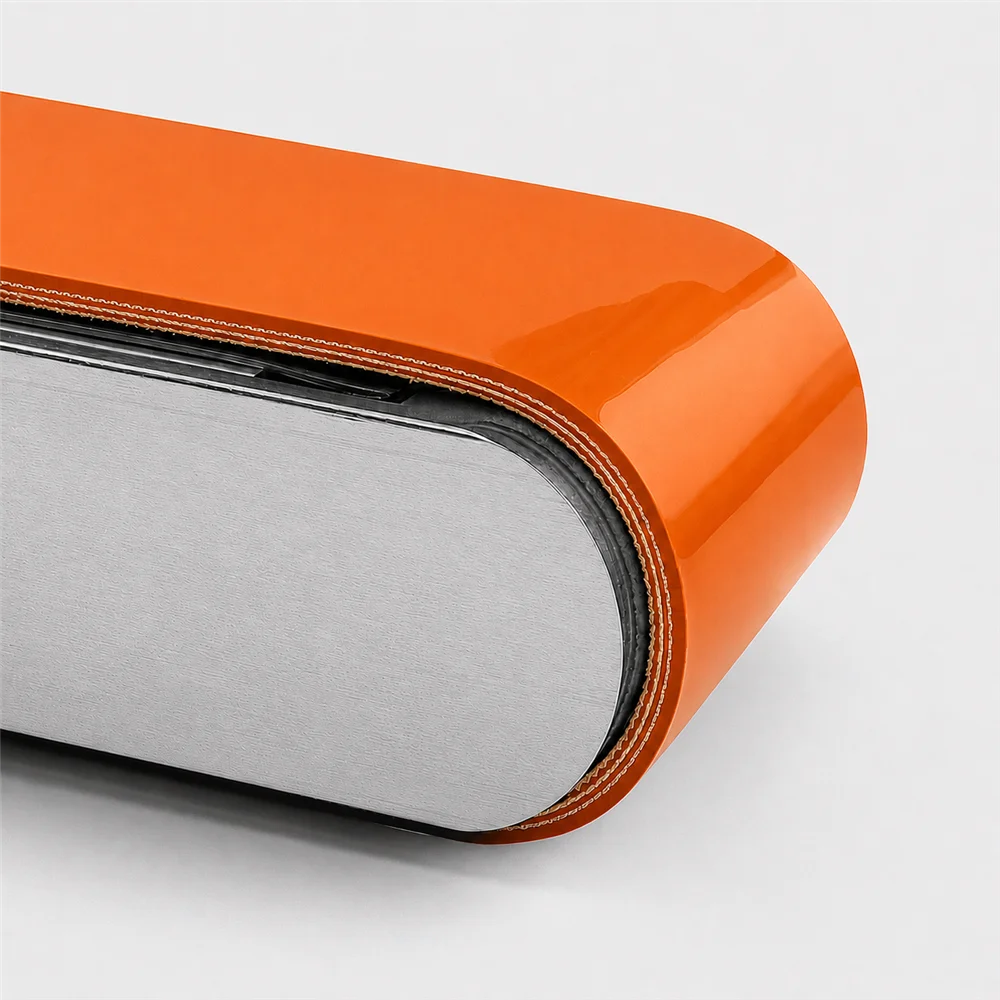


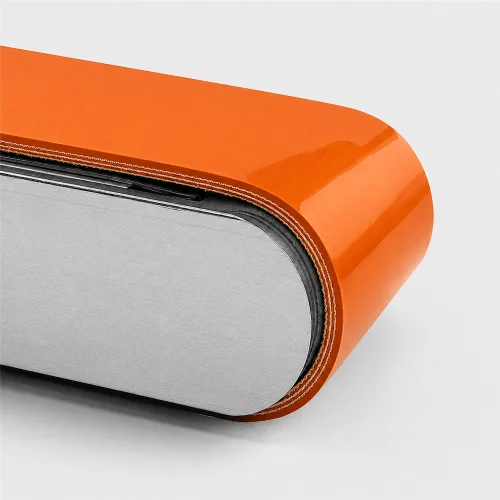
EM18/3-T18+08 is a PVC conveyor belt in orange with a total thickness of 4.0 mm. This type has been selected for industrial transport tasks, where the belt's structure, surface, stability and splice must suit the specific machine rather than just a nominally corresponding belt width. We assemble the finished conveyor belt to measure, so that length, width, splice and any post-processing can be adapted to the conveyor. The variant is particularly relevant for internal transport of boxes, components, packaging and process goods, but can also be a good starting pu for packaging and sorting lines, where stable belt guidance and wear resistance are important. The combination of antistatic, oil and grease resistant, T18 profile means that the product can be described precisely in a spare parts list and reordered without reducing the specification to just color and thickness.
The code EM18/3-T18+08 indicates an EM construction with 3 fabric layers. The supplier sheet marks the belt as transversely stable. The nominal tensile force at 1% elongation is 18 N/mm, and the belt's fabric is based on polyester. The transversely stable construction is relevant when the belt must maintain its shape and groove stably on the conveyor.
The carrier side is made with a coarse diamond profile (T18). The profile increases the mechanical contact between the belt and the workpiece compared to a completely smooth surface and can be an advantage during acceleration, braking, minor inclines or products with a smooth underside. The specific inclination angle cannot be determined from the profile name alone; it depends on the product material, weight, pu of gravity, moisture, temperature and transport speed. Therefore, the profile selection should always be assessed together with samples or known operating data from the plant. The running side and the fabric construction also have an impact on energy consumption, noise and stable belt guidance. A belt must be able to run centered without unnecessarily high drag, and therefore the conveyor's slide plate, rollers, drum coating and grooveing should be checked if an old belt has been worn out. The registered coefficient of friction against steel in the technical product family is around 0.2; the figure should be used as a technical reference and not as a guarantee for a specific inclination angle or traction force, because friction changes with the condition of the surface, dirt, moisture and temperature.
In practice, this type is often used when a reproducible belt specification is required for material handling in production, splice and internal logistics. The precise belt code makes it easier to distinguish between smooth, profiled, food-safe, antistatic, flame-retardant and oil/grease-resistant variants. This is particularly important when reordering, because a generic description such as “orange PVC belt” or “white PU belt” does not provide any reliable information about the fabric layer, k1 value, surface profile or permitted drum diameter. By maintaining the entire code, maintenance, purchasing and production can communicate about the same technical product.
The minimum drum diameter must be validated for the specific conveyor, as the existing product data is not unambiguous on this pu . The minimum drum diameter is a key operating parameter, because a drum or roller system that is too small increases the bending stress in the fabric and coating and can shorten the service life or put unnecessary strain on the joint. In the case of knife transitions, small nose rollers or counter-bends, it is therefore always necessary to check separately whether the belt type is suitable. The diameter should be assessed together with the belt speed, load, start/stop frequency and whether the belt runs over a slide plate or rollers. Correct tensioning is equally important: too high a pretension puts extra strain on the bearings and joint, while too low a tension can cause slippage and unstable grooveing.
This variant is registered as antistatic and oil resistant in the supplier's product overview. This makes it relevant where static charging needs to be limited and where the belt may be exposed to oil. It is not marked as food-grade in the supplier's sheet and should therefore not be described as food-grade without separate documentation.
Regardless of the property codes, cleaning and maintenance should be adapted to the actual operating environment. High temperature, steam, aggressive cleaning agents, oil, sharp product edges and continuous mechanical wear can affect a conveyor belt differently. The stated temperature range of -10 to +80 °C is a technical reference for the belt family; continuous operation close to a limit should always be assessed together with mechanical load and the specific process. For sensitive or regulated applications, we can take the necessary documentation as a starting pu when determining the final belt design.
We manufacture the finished belt solution by cutting the material to the desired width and length, preparing the joint and finishing the belt according to the conveyor requirements. For thermoplastic PVC and PU belts, a finger joint is often the preferred endless solution because it provides a smooth transition and distributes the tension across the joint zone. In other systems, a mechanical joint may be relevant, for example when the belt must be installed without dismantling the machine. The choice depends on thickness, minimum drum diameter, cleaning requirements, product contact and how much space there is around the conveyor.
Post-processing can also include cutting, v-guides, carriers or other details, if the belt design and application allow it. Such options must always be technically assessed, because a profile or carrier changes the belt's bending properties and can place greater demands on the drum diameter and splice method. When replacing, we therefore recommend recording the existing belt code, endless length, actual width, drum diameters, whether there is counter-bending, and how the belt is tensioned. This provides a much more secure basis than just measuring the dismantled belt.
Don’t choose based on price per square meter alone. The cheapest belt type can be expensive if it causes frequent stops, poor grooveing or a short service life. Instead, compare construction, number of fabric layers, k1 value, total thickness, surface, minimum drum diameter, temperature, special properties and the required splice. For EM18/3-T18+08, the strength is precisely that these properties are combined in a clear specification. If you are replacing an existing belt, the full code is usually the best starting pu ; if a code is not available, we can identify the need based on measurements and operating data.
To dimension correctly, you should provide the endless length, belt width, minimum drum diameter, any counter-bending, speed, product weight and type, and whether the belt runs on a slide plate or rollers. Also provide information on oil, grease, moisture, cleaning chemicals, food contact or flame retardant requirements. This way, we can check whether this variant is the right choice and assemble a conveyor belt that fits the specific machine. The final suitability always depends on the entire conveyor system, but a correctly specified belt type provides a much better starting pu for stable operation, easy reordering and planned maintenance.