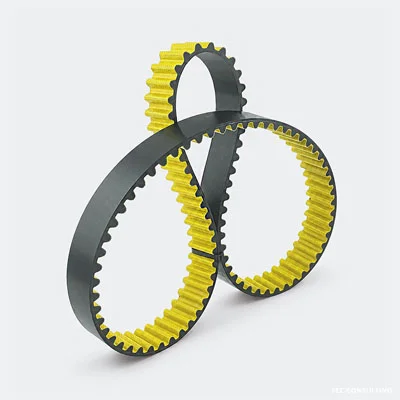
Timing belts for industry
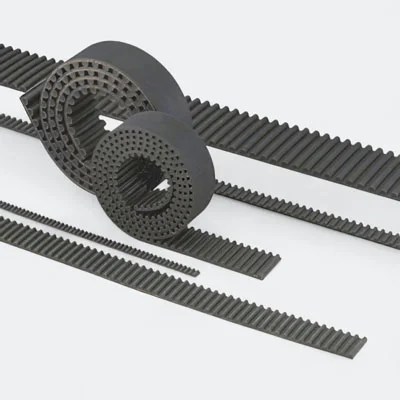
We offer a wide range of open and integral timing belts in durable rubber and polyurethane, which can be processed with e.g. v-guides, carriers, vacuum holes and a surface coating of your choice. We also offer a wide range of different timing belt accessories such as clamping plates, tension rollers, slide rails and metal teeth. Regardless of whether you are in the food industry with sky-high requirements for food handling, or you have your daily routine in the bulk industry, where raw strength is a necessity, we have the right solution for you.
Timing belts are manufactured with "teeth" and are driven by timing belt pulleys that ensure the belt's position in the groove, unlike, for example, V-belts and flat belts that are driven by the friction that occurs between the belt and the pulley. A timing belt thus keeps its connected shafts in the same rhythm and in this context a high tensile strength and precision are achieved, as no slip can occur.
We are a complete supplier and distributor of timing belts with brands such as Megadyne, PIX, Optibelt, Elatech, Gates , Ammeraal and Contitech as our primary manufacturers. Our collaboration with factories across the industry gives us a large number of timing belts and accessories in our range, which means that we can deliver timing belt solutions that exceed our customers' expectations for quality, price and delivery time. We always guarantee qualified advice, so that you always get the right guidance on which timing belt is right for your project.
At FEC Consulting, we can always customize your timing belts to achieve the exact specifications and properties you want. We also help you with sizing and calculating timing belts, so you are sure to receive the right timing belts every time.
Important knowledge about polyurethane and rubber timing belts
Timing belts are important components in many industrial machines and are used in various types of applications – from simple factory automation to advanced robotics. When choosing a timing belt for your new or existing machine, it is important to consider whether you should use a polyurethane ( PU ) or a rubber timing belt, both have certain advantages and disadvantages, as it is important that your timing belt fits the working environment in which it will be used, by reading the rest of the text below you will learn how to choose the right belt type.
Timing belts made of polyurethane ( PU ):
Polyurethane timing belts are known for their high strength, durability and resistance to wear. They are made from a thermoplastic material that is ideal for high-precision applications that require precise positioning and motion control. PU timing belts can be reinforced with steel, Kevlar or stainless steel reinforcement, this provides strength to the belt, stainless steel reinforcement is often used in the food industry for product transport. A PU timing belt can be purchased in solid, open or welded lengths. Most PU timing belts run in timing belt pulleys as standard are made of aluminum.
Advantages of PU timing belts:
- High strength and durability as well as high resistance to wear.
- High precision for accurate positioning and control.
- Available in a wide range of sizes and designs.
- High chemical resistance, making them very easy to clean as they withstand aggressive cleaning agents.
- Available in open lengths and can be welded to endless belts.
Disadvantages of PU timing belts:
- Higher costs compared to rubber timing belts.
- Limited flexibility at low temperatures.
- Limited resistance to UV rays from the sun.
Rubber timing belts:
Rubber timing belts are made from synthetic rubber and are a more cost-effective solution than PU timing belts. They are ideal for medium-duty applications that require high precision and accuracy. Rubber timing belts can be reinforced with fiberglass or steel cords for extra strength and are available in a wide range of sizes and designs.
Advantages of rubber timing belts:
- Advantages: Lower costs compared to PU timing belts.
- Higher strength and durability compared to a PU timing belt.
- Good flexibility at cold temperatures.
- High precision and accuracy.
- Rubber timing belts withstand outdoor use.
- Good resistance to sustained vibrations.
Disadvantages of rubber timing belts:
- Poor resistance to oil and chemical attack
- Limited heat resistance
- Limited resistance to UV rays from the sun
- Available in standard lengths only and cannot be welded to endless belts
Find the perfect timing belt for your needs: Buy a new timing belt with these helpful tips
When buying a new timing belt, there are several factors to consider. Timing belts are an important part of many machines and mechanisms, so it is important to find the right timing belt that suits your specific needs. Here are some tips on how to choose the best timing belt:
1. Check the dimensions of the timing belt
- Length
- Width
- Tooth pitch (profile)
It is important to know the dimensions of the timing belt to ensure that it fits the timing pulley correctly. If you do not know the tooth pitch, you can measure the distance between the tooth centers or use our online belt calculator to find the correct dimensions.
2. Consider the environment used
- Indoor or outdoor
- Food transport
- Heavy industry
Timing belts are available in various materials such as polyurethane ( PU ) and rubber. The choice of material depends on the environment in which the timing belt will be used.
3. Identify the requirements for the application
- Load capacity
- Speed
- Temperature range
Understand the requirements of the specific application where the timing belt will be used so you can choose the best solution to meet those requirements.
4. Adjust the timing belt to your needs
- Reinforcement
- Steering profile
- Cleats
- Vacuum holes
Consider customizing your timing belt with special features if your application has special requirements that cannot be met by standard timing belts.
By following these tips, you can purchase the perfect timing belt that suits your needs and ensures optimal performance and longevity. Always remember to maintain and inspect your timing belts regularly to maintain optimal operation and extend their lifespan.
It is therefore important to consider your needs when choosing a timing belt. Polyurethane and rubber timing belts each have their own advantages, so make sure you choose the type that is best suited to your industry. It is also crucial that you size your timing belt correctly, as this plays a crucial role in the precision, efficiency and performance of the timing belt drive.



.webp)