Log in
Log in to account
Enter your username and password
Forgot your password?
Forgot password
Don't have an account yet?
Create an account
Sign Up
Request a product
Your list of queries is empty
Request a product. We will respond to your inquiry as soon as possible.
Shopping Cart
Your cart is empty!
Shop further and find the products you are looking for. The shopping cart will wait here until you are ready to order.


Manufacturer


Item number
CXPV177814040

Delivery time1-3 working days
Effective length: 1778mm•
Number of teeth: 127•
Tooth profile: HTD 14M•
Reinforcement type: Fiberglass•
Material: Rubber•
Mark: Continental
Save
20%
Original price
2.745,00 DKK
2.196 DKK
incl. VAT2.745,00 DKK
You save
549,00 DKK

Discount
20%

Original price
2.745,00 DKK
Quantity Discounts
Discount
You save
Price per pcs.
1 - 4 pcs.
52%
2.379,00 DKK
2.196 DKK
5 - 9 pcs.
57%
2.599,00 DKK
1.976 DKK
10 - 19 pcs.
59%
2.708,00 DKK
1.867 DKK
+20 pcs.
62%
2.840,00 DKK
1.735 DKK
Description
Timing belt CXP 1778 14M - CONTI® SYNCHROFORCE
Timing belt CXP 1778 14M - CONTI® SYNCHROFORCE is a technical rubber timing belt in the CONTI® SYNCHROFORCE CXP version. The belt has an HTD 14M CXP profile, an effective length of 1778 mm and 127 teeth. It is used in timing belt drives where power and movement must be transmitted precisely via tooth meshing.
Product data
- Effective length: 1778 mm
- Number of teeth: 127
- Tooth profile: HTD 14M CXP
- Tooth pitch: 14 mm
- Profile type: HTD 14M in CXP version
- Tooth height: 6.1 mm
- Belt height: 10.0 mm
- Standard widths: 40 mm, 55 mm, 85 mm, 115 mm and 170 mm
- Length tolerance: ±0.43 mm
- Material: Chloroprene rubber
- Reinforcement: Fiberglass reinforcement
- Tooth surface: Prepared polyamide tissue on the tooth side
- Series: CONTI® SYNCHROFORCE CXP
Construction and materials
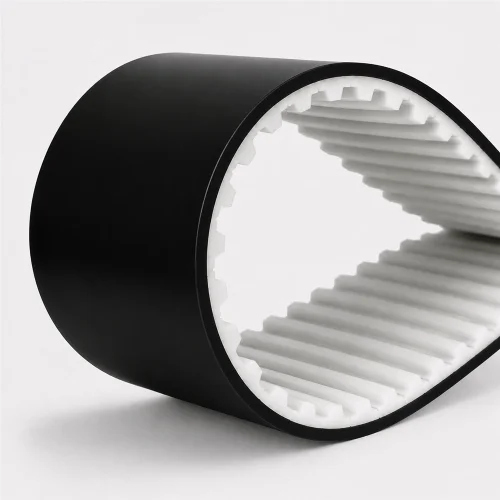
The belt is constructed with a synthetic rubber backing, synthetic rubber teeth, fiberglass reinforcement and polyamide fabric on the tooth surface. This construction provides a combination of flexibility, tensile strength and wear resistance. The backing and teeth are made of chloroprene-based rubber, while the fiberglass reinforcement is the load-bearing reinforcement in the belt. This provides a belt that can absorb tensile forces and still maintain synchronous function, while the rubber part can bend around the timing belt pulleys during repeated rotations.
The polyamide fabric on the teeth is an important part of the belt's wear surface. It lies between the tooth rubber and the profile of the timing belt pulley and contributes to lower friction, smoother engagement and better protection of the tooth surface. In a CXP belt, the material layers are not separate functions, but parts of an overall construction where flexibility, tensile strength and tooth stability must work simultaneously.
Profile and tooth engagement
The CXP 14M uses a metric tooth pitch of 14 mm. The HTD tooth shape has a semi-circular profile, which provides a large and stable engagement surface between the belt and the timing belt pulley. This shape is known for its high safety against tooth skipping, because the tooth can engage deeply and smoothly into the profile of the timing belt pulley. For this belt, the 1778 mm effective length means that the belt has 127 teeth distributed around the endless belt.
The large tooth pitch and high tooth profile provide a robust tooth engagement surface for powerful belt drives with high torque. The profile is also part of the CXP series, where ContiTech has combined tooth shape, reinforcement and rubber compound for operation under demanding loads. The technical length tolerance for this length class is ±0.43 mm. The tolerance covers the manufacturer's effective length and pulleybase deviation.
Operating characteristics
CONTI® SYNCHROFORCE CXP is designed for high belt speeds and high dynamic loads and can be used at belt speeds of up to 50 m/s. The high load capacity is due, among other things, to the specially developed reinforcement and the strong material bond between rubber, reinforcement and tooth surface. This gives the belt high residual tensile strength and improved resistance to tooth shearing under heavy loads.
The belt transmits motion synchronously, so that the driving and driven shafts maintain a fixed speed ratio. It works without lubrication and is designed for maintenance-free operation. The optimized profile matching between the timing belt and timing belt pulley, together with the polyamide fabric on the tooth side, contributes to quiet operation. In demanding operation, this is an important property, because both tooth engagement and load variation can affect the sound level and stability.
Resistance to operating environment
The CXP version is temperature resistant from -20 °C to +100 °C depending on the application. The belt is ozone resistant, suitable for tropical climates, conditionally/moderately oil resistant and electrically conductive according to ISO 9563. These properties make the belt suitable for industrial environments where temperature, air, oily influences and static electricity can affect operation.
The rubber-based construction also provides some damping in the drive. The timing belt can therefore be used in solutions where a quieter and lighter transmission is desired than chain or sprocket drives. The function of the belt still depends on the mechanical structure around it, but the CXP construction itself is made to maintain strength and flexibility under repeated loads.
Application
In a belt drive with correctly aligned timing belt pulleys, the movement is transmitted through the tooth engagement rather than friction. This provides a solid mechanical connection between the belt teeth and the profile of the timing pulley. Heavy synchronous drives, larger machines, main drives and industrial systems where the belt must transmit high power over larger timing belt pulleys. It can be used in industrial systems where synchronous operation, high efficiency and stable power transmission without lubrication are required. The CXP series is particularly relevant in fast-running drives where a standard timing belt does not provide the same load reserve.
The effective length of 1778 mm and the CXP 14M profile make this belt a specific dimension in the series. The belt fits into timing belt pulleys with a corresponding tooth pitch and tooth shape. When timing belt pulleys and belt have the same tooth profile, the load is distributed over the teeth that work in mesh and the movement is transmitted without the slip known from friction-based belt types.
Installation and ongoing operation
In a synchronous belt drive, belt tension, the condition of the timing belt pulleys and the parallelism of the shafts are important for the life of the belt. A CXP belt works best when the tooth surfaces can move cleanly in and out of the profile of the timing belt pulleys. Too low a tension can cause unstable tooth engagement, while unnecessarily high tension can increase the load on bearings, shafts and reinforcement. A correctly constructed transmission utilizes the strength of the belt without overloading its materials.
The belt is endless without joints. This provides a uniform structure all the way around and is an advantage in dynamic operation because the belt does not have a weaker joint pu . The same construction makes the belt suitable for repeated accelerations, uniform rotational speed and operation with continuous tooth engagement.
Question about the belt
Can CXP run without lubrication?
Yes. SYNCHROFORCE CXP is a timing belt for dry, synchronous power transmission and does not require lubrication. This distinguishes it from chain drives, where lubrication is typically part of the operation.
What does an HTD tooth shape mean?
HTD stands for High Torque Drive. The semi-circular tooth shape provides good protection against tooth skipping and is suitable for power transmission with high torque.
What does tooth division mean?
The tooth pitch is the center-to-center distance between two adjacent teeth measured along the belt's pitch line. A 14M belt has a tooth pitch of 14 mm.
What does CXP mean on this timing belt?
CXP is ContiTech's reinforced version for belt drives with high belt speeds and high dynamic loads. The series is designed for the synchronous transmission of power and motion in industrial drives.
What does the fiberglass reinforcement in the belt do?
The fiberglass reinforcement acts as reinforcement and helps the belt maintain its length under load. This is important in synchronous belt drives, where tooth position and the effective length of the belt have a direct impact on operation.
Backflex and the use of a tension roller can be included in certain CXP designs when the belt drive is dimensioned for it. The flexibility of the belt and rubber-based construction make it suitable for dynamic grooves, but the bend radius, roller size and belt tension always have an impact on the load in the reinforcement and the tooth root.
The rubber matrix of the belt provides cushioning and flexibility, while the fiberglass reinforcement absorbs the tensile load. The timing fabric on the inside is the part of the belt that works directly against the timing belt pulley. In practice, these parts must work together: the rubber must be able to bend around the timing belt pulleys, the reinforcement must limit length change, and the tooth surface must resist wear from repeated engagement.
The effective length is the pitch length of the belt and the length value used to identify the timing belt. The number of teeth follows from the length and the pitch. For this belt, 1778 mm length and 14 mm pitch give 127 teeth. This relationship is important because the number of teeth determines how the belt fits in relation to the number of teeth on the timing belt pulleys and the center distance in the drive.
The technical length tolerance for this length class is ±0.43 mm. The tolerance describes the manufacturer's level of precision for the belt's effective length and is used when assessing the center distance and belt tension in a synchronous drive. A timing belt of this type is therefore not only defined by its name and profile, but also by the exact length class and the tolerances associated with it.
The CXP series is designed for maintenance-free operation. This means that the belt itself does not require lubrication, and that the design is made to maintain stable function without the continuous lubrication often associated with chain drives. However, maintenance-free does not mean that the belt drive is independent of mechanical quality. Clean timing belt pulleys, correct tension and a stable shaft structure continue to be important for service life and smooth operation.