DISCOUNTED


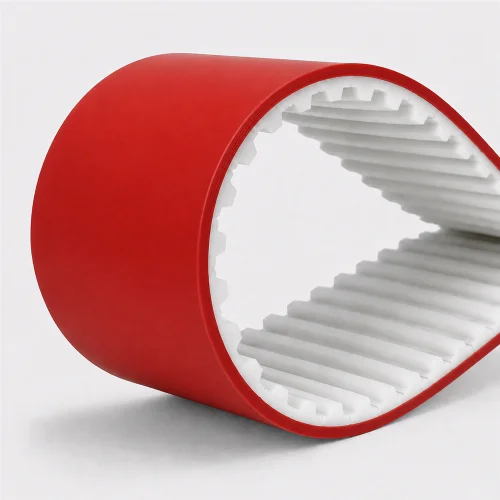
Timing belt CXP 425 5M - CONTI® SYNCHROFORCE is an endless rubber timing belt for synchronous power transmission in industrial belt drives. The profile is HTD 5M CXP, the length is 425 mm, and the belt has 85 teeth. The teeth work in mesh with the timing belt pulley and maintain a fixed movement between the shafts.
The CXP series is distinguished by incorporating a strong fiberglass reinforcement into a chloroprene-based belt. The tooth surface is covered with a specially treated polyamide fabric, which reduces friction in the tooth engagement and protects the tooth during operation. The back and teeth are made of chloroprene-based rubber, while the fiberglass reinforcement is located as the load-bearing reinforcement in the belt. This results in a belt that can absorb tensile forces and still maintain synchronous function, while the rubber part can bend around the timing belt pulleys during repeated rotations.
The polyamide fabric on the teeth is an important part of the belt's wear surface. It lies between the tooth rubber and the profile of the timing belt pulley and contributes to lower friction, smoother engagement and better protection of the tooth surface. In a CXP belt, the material layers are not separate functions, but parts of an overall construction where flexibility, tensile strength and tooth stability must work simultaneously.
CXP 5M uses a metric tooth pitch of 5 mm. The HTD tooth shape has a semi-circular profile, which provides a large and stable engagement surface between the belt and the timing belt pulley. This shape is known for its high safety against tooth skipping, because the tooth can engage deeply and smoothly into the profile of the timing belt pulley. For this belt, the 425 mm effective length means that the belt has 85 teeth distributed around the endless belt.
The tooth pitch provides a good balance between compact belt construction, tooth strength and smooth running in a dynamic belt drive. The profile is also part of the CXP series, where ContiTech has combined tooth shape, reinforcement and rubber compound for operation under demanding loads. The technical length tolerance for this length class is ±0.25 mm. The tolerance covers the manufacturer's effective length and pulleybase deviation.
CONTI® SYNCHROFORCE CXP is designed for high belt speeds and high dynamic loads and can be used at belt speeds of up to 50 m/s. The high load capacity is due, among other things, to the specially developed reinforcement and the strong material bond between rubber, reinforcement and tooth surface. This gives the belt high residual tensile strength and improved resistance to tooth shearing under heavy loads.
The belt transmits motion synchronously, so that the driving and driven shafts maintain a fixed speed ratio. It works without lubrication and is designed for maintenance-free operation. The optimized profile matching between the timing belt and timing belt pulley, together with the polyamide fabric on the tooth side, contributes to quiet operation. In demanding operation, this is an important property, because both tooth engagement and load variation can affect the sound level and stability.
The CXP version is temperature resistant from -20 °C to +100 °C depending on the application. The belt is ozone resistant, suitable for tropical climates, conditionally/moderately oil resistant and electrically conductive according to ISO 9563. These properties make the belt suitable for industrial environments where temperature, air, oily influences and static electricity can affect operation.
The rubber-based construction also provides some damping in the drive. The timing belt can therefore be used in solutions where a quieter and lighter transmission is desired than chain or sprocket drives. The function of the belt still depends on the mechanical structure around it, but the CXP construction itself is made to maintain strength and flexibility under repeated loads.
The endless construction makes the belt suitable for continuous operation because there is no welding or joining in the belt. This contributes to uniform strength all the way around the belt. Synchronous machine drives, packaging machines, light transport functions and technical systems with requirements for low slip and stable speed. It can be used in industrial systems where there is a need for synchronous operation, high efficiency and stable power transmission without lubrication. The CXP series is particularly relevant in fast-running drives where a standard timing belt does not provide the same load reserve.
The effective length of 425 mm and the CXP 5M profile make this belt a specific dimension in the series. The belt fits into timing belt pulleys with a corresponding tooth pitch and tooth shape. When timing belt pulleys and belt have the same tooth profile, the load is distributed over the teeth that work in mesh and the movement is transmitted without the slip known from friction-based belt types.
In a synchronous belt drive, belt tension, the condition of the timing belt pulleys and the parallelism of the shafts are important for the life of the belt. A CXP belt works best when the tooth surfaces can move cleanly in and out of the profile of the timing belt pulleys. Too low a tension can cause unstable tooth engagement, while unnecessarily high tension can increase the load on bearings, shafts and reinforcement. A correctly constructed transmission utilizes the strength of the belt without overloading its materials.
The belt is endless without joints. This provides a uniform structure all the way around and is an advantage in dynamic operation because the belt does not have a weaker joint pu . The same construction makes the belt suitable for repeated accelerations, uniform rotational speed and operation with continuous tooth engagement.
The tooth pitch is the center-to-center distance between two adjacent teeth measured along the belt's pitch line. A 5M belt has a tooth pitch of 5 mm.
CXP is ContiTech's reinforced version for belt drives with high belt speeds and high dynamic loads. The series is designed for the synchronous transmission of power and motion in industrial drives.
The fiberglass reinforcement acts as reinforcement and helps the belt maintain its length under load. This is important in synchronous belt drives, where tooth position and the effective length of the belt have a direct impact on operation.
The polyamide fabric protects the tooth surface, reduces friction in the engagement and contributes to smoother operation between the belt and the timing belt pulley. This is especially relevant at higher speeds and repetitive loads.
Yes. SYNCHROFORCE CXP is a timing belt for dry, synchronous power transmission and does not require lubrication. This distinguishes it from chain drives, where lubrication is typically part of the operation.
The CXP series is designed for maintenance-free operation. This means that the belt itself does not require lubrication, and that the design is made to maintain stable function without the continuous lubrication often associated with chain drives. However, maintenance-free does not mean that the belt drive is independent of mechanical quality. Clean timing belt pulleys, correct tension and a stable shaft structure continue to be important for service life and smooth operation.
The standard widths for this profile are 9 mm, 12 mm and 15 mm. The different widths allow the same length and tooth pitch to be used in belt drives with different power loads. A wider belt can distribute the load over a larger tooth surface, while a narrower belt can be an advantage where space and rotating mass must be kept to a minimum.
CXP series timing belts do not rely on friction in the same way as a friction-based belt type. The power is transmitted through the positive tooth meshing, where the teeth of the belt fit into the profile of the timing pulley. When the tooth meshing is stable, the relationship between the driving and driven shafts is maintained. This property is central in machines where uniform motion, repeatability and fixed gear ratios are part of the function.
The effective length is the pitch length of the belt and the length value used to identify the timing belt. The number of teeth follows from the length and the pitch. For this belt, 425 mm length and 5 mm pitch give 85 teeth. This relationship is important because the number of teeth determines how the belt fits in relation to the number of teeth on the timing belt pulleys and the center distance in the drive.
The rubber matrix of the belt provides cushioning and flexibility, while the fiberglass reinforcement absorbs the tensile load. The timing fabric on the inside is the part of the belt that works directly against the timing belt pulley. In practice, these parts must work together: the rubber must be able to bend around the timing belt pulleys, the reinforcement must limit length change, and the tooth surface must resist wear from repeated engagement.