New
DISCOUNTED


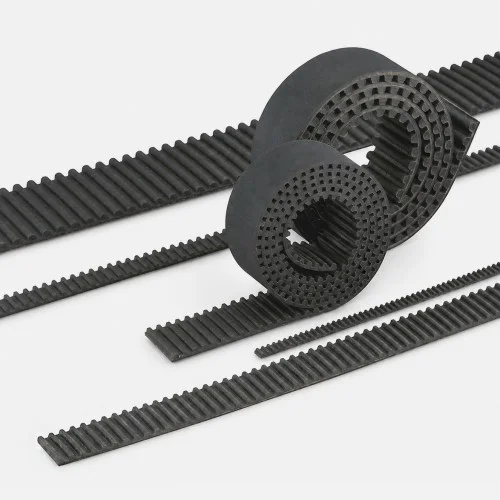
Gates open timing belt HTD 5M steel - Long Length is a Gates Long Length timing belt in profile HTD 5M. It is supplied as an open timing belt/open-end, so it can be used as a meter item and adjusted to the length that suits the specific machine. This variant has a width of 20mm and is indicated with steel as reinforcement in supplier data. This type of long length timing belt is typically used when building or servicing a drive where the belt path is longer or more flexible than a standard endless timing belt.
In Danish, this type of product is typically referred to as a open rubber timing belt, one long length timing belt, one open-end timing belt or one timing belt on a rollThe terms are used slightly differently in catalogs and webshops, but the point is the same: the belt is not produced as a finished endless ring, but as an open length that can be shortened or processed as needed.
An open timing belt is used to transfer motion precisely between gears, linear guides, axes or other machine components. Unlike a smooth belt, the teeth of the timing belt work together with the geometry of the gear. This means that the belt can provide more precise motion because the engagement between the teeth and pulley helps to keep the positioning stable. An open rubber timing belt like this is often used in conveyor equipment, packaging machines, linear motion, lifting/pulling systems, door solutions, automation and special machines where you need to be able to choose a length that is not necessarily available as a standard endless belt.
HTD 5M is an HTD profile with a 5 mm tooth pitch. It should be used with pulleys that match the same HTD profile. It is important not only to compare the width, because the tooth shape must also match the pulley. The profile is therefore one of the most important choices in the entire belt drive. If you are replacing an existing belt, you should check the profile, width, tooth pitch and any markings of the old belt. If you are building a new drive, the belt and pulley should be selected together so that the tooth shape, width and load match each other.
Open-end timing belts are useful when the length of the belt must be determined based on the machine and not based on a fixed catalog length. A regular endless timing belt is closed in a ring and has a fixed effective length. A long length timing belt, on the other hand, is delivered as an open length, often from a roll or by the meter. This provides flexibility for new builds, conversions and service because the belt can be adapted to the stroke length, center distance and mounting conditions.
For a customer, this means that you don't just have to look for a specific finished belt size. Instead, you can pu from the profile, width, material, reinforcement and the length that will actually be used. Therefore, search terms such as Long Length, open-end, open timing belt, open rubber timing belt and timing belt by the meter are relevant for the same product group. They describe the same practical solution from different angles.
The most important rule when choosing a timing belt is that the tooth profile must match the pulley. An HTD 5M belt should not be selected based on width or tooth pitch alone, but on the overall geometry. If the belt does not fit the pulley correctly, it can cause noise, uneven engagement, increased wear and poor operation. It can also make troubleshooting more difficult because the belt may at first glance look like a different profile.
The width of 20mm is also important. A wider belt can usually transmit more power than a narrow belt of the same profile, but it requires corresponding pulleys and space in the construction. A belt that is too narrow can be overloaded, while a belt that is too wide can cause mounting problems. Therefore, the width should always be checked in relation to both pulleys, load and the space available in the machine.
Steel reinforcement is used when the belt needs to have high strength and low elongation. This may be relevant for longer open lengths, higher loads or installations where precise length stability is important. The reinforcement is especially important for open belts because the length is often greater than on small endless belts. When the belt is working over a longer distance, length stability and correct tensioning become more crucial for the result.
If the product is to be used in a linear motion, low elongation may be important for repeatability. If the belt is to be used in a conveyor system, smooth operation, low wear and correct guidance may be more important. The right combination of profile, width and reinforcement therefore depends on the specific application.
The material is specified as chloroprene rubber. This makes the belt suitable as an open rubber timing belt for many industrial environments where a robust timing belt on a roll/meter is desired. Chloroprene rubber is often used for rubber timing belts because the material can combine flexibility, wear resistance and good operational reliability in common belt drives. The material information should always be read together with the profile and reinforcement. A timing belt is not just a rubber belt; it consists of teeth, a back, a tension body and a geometry that must work together with the pulley. Therefore, you should not replace one type of timing belt with another without checking all relevant data.
In practice, you should check in particular: tooth profile, tooth pitch, width, reinforcement, pulley, pulleybase, load, speed, temperature conditions, need for precise positioning and whether the belt is to be used open or assembled later. If any of these pu are unclear, it is better to check it before ordering than to fit a belt that only almost fits.
Gates Long Length timing belts are used in many types of technical systems. These can be in linear axes, conveyor belts, machine guards, automatic doors, packaging machines, sorting systems, robot-related movements, pulling stations and custom-built solutions. Common to the tasks is that you want a timing engagement so that the belt can transmit movement more precisely than a smooth belt.
This HTD 5M variant is therefore relevant for customers who are looking for a specific Gates profile, but who also need an open belt instead of a standard endless length. When the product is found via searches such as open timing belt, Gates long length, open-end timing belt, rubber timing belt by the meter or Gates HTD 5M timing belt, the text should help the customer understand the difference and make the right choice.
When ordering an open timing belt, the length should normally be determined based on the machine design. On a linear system, the required belt path is measured based on the stroke, attachments and any belt tensioners. When rebuilding, the old belt can be used as a starting pu if it is not stretched, damaged or mislabeled. Remember that an open belt should not be confused with an endless belt, where the length is defined as a closed circumference.
If the belt is to be assembled, clamped or secured in a holder later, additional length for attachment and adjustment must also be taken into account. This is particularly relevant in linear drives, where the belt is not just around two pulleys, but is part of a mechanical movement. When in doubt, it is an advantage to have information about pulleys, center distance, desired length, load and existing belt marking.
Yes, in this product group Long Length and open-end are often used to refer to open timing belts that are delivered by the meter or by the roll. In Danish, many people would call it an open rubber timing belt. This does not mean that the belt is a finished endless ring from the factory.
Not without checking the task. An open timing belt and an endless timing belt are not always used in the same way. An open belt is suitable for meter measurements, linear movements and solutions where the belt is fixed or machined. An endless belt is closed and is selected according to effective length and number of teeth.
The width of this variant is 20 mm. The width has an impact on the capacity of the belt, on the space in the pulley and on the way the belt is guided in the structure. If the width does not match the pulley or the load, the operation may become unstable.
Check at least the profile, width, reinforcement, material type, existing belt marking, pulley type and desired length. For this item, the key data is HTD 5M, 20 mm, steel and Gates Long Length/open-end design.
Gates open timing belt HTD 5M steel - Long Length is an open Gates timing belt for meter/open-end use. It is relevant when you need a HTD 5M profile in 20 mm width and with steel as reinforcement. Choose this type when you need a long length timing belt, where the length must be adapted to the machine, and where the correct profile, width and pulley are essential for a stable solution.
A good practical tip is to take a picture of the old belt marking and measure the width before ordering. On many open timing belts, the text may be worn, but the profile and width can still be measured. When you compare the measurement with HTD 5M, 20 mm width and the selected reinforcement, the risk of ordering incorrectly is reduced. This is especially important for machines where several belt profiles are visually similar.
If the belt is part of a critical machine, the sizing should not be based on price alone. A correctly selected open timing belt can reduce stops, improve repeatability and make maintenance easier. Conversely, a belt with the wrong profile or width can cause faster wear on both the belt and pulley. Therefore, the technical information in this description is written so that both purchasers and technicians can check the most important pu .