Log in
Log in to account
Enter your username and password
Forgot your password?
Forgot password
Don't have an account yet?
Create an account
Sign Up
Request a product
Your list of queries is empty
Request a product. We will respond to your inquiry as soon as possible.
Shopping Cart
Your cart is empty!
Shop further and find the products you are looking for. The shopping cart will wait here until you are ready to order.


Manufacturer


Item number
MD-RPP5-225

Delivery time1-4 working days
Effective length: 225mm•
Number of teeth: 45•
Tooth profile: RPP 5M•
Reinforcement type: Fiberglass•
Material: Rubber•
Mark: Megadyne
Save
20%
Original price
85,00 DKK
68 DKK
incl. VAT85,00 DKK
You save
17,00 DKK

Discount
20%

Original price
85,00 DKK
Quantity Discounts
Discount
You save
Price per pcs.
1 - 4 pcs.
20%
17,00 DKK
68 DKK
5 - 9 pcs.
28%
24,00 DKK
61 DKK
10 - 19 pcs.
32%
27,00 DKK
58 DKK
+20 pcs.
36%
31,00 DKK
54 DKK
Description
Megadyne MEGASYNC 225 RPP 5M rubber timing belt
Important product details
- Effective length: 225 mm
- Number of teeth: 45
- Tooth profile: RPP 5M
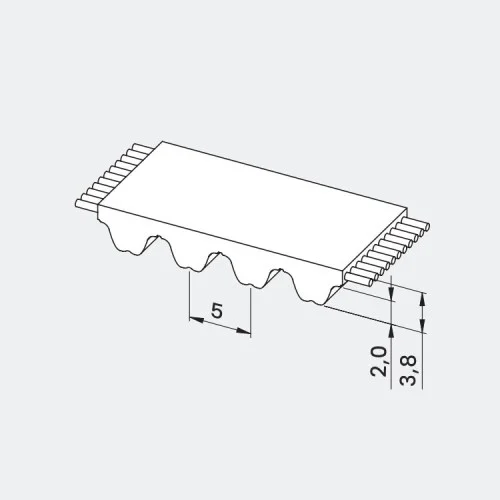
- Tooth pitch: 5.0 mm
- Design: Single-timing
- Material: Rubber
- Traction body: Fiberglass
- Tooth coating: Nylon fabric
- Tooth height: 2.00 mm
- Belt height: 3.80 mm
- Standard widths: 9 mm, 15 mm, 25 mm
- Brand: Megadyne MEGASYNC
Megadyne MEGASYNC 225 RPP 5M rubber timing belt is an endless rubber timing belt from Megadyne's MEGASYNC series. The product has a pitch length of 225 mm, 45 teeth, RPP 5M profile and standard widths of 9mm, 15mm, 25mm. In a synchronous belt drive, the movement is transmitted through the tooth engagement between the belt and pulley, which provides a stable and precise operation without the slippage associated with ordinary friction belts. The belt is manufactured for synchronous drives, where the movement must be transmitted technically robustly between pulleys without slipping. The fixed tooth pitch and the endless structure provide a uniform circulation, while the RPP profile contributes to lower noise and better engagement in the profile pulleys.
Product data and profile
The stated length of 225 mm is the belt's pitch length, i.e. the length measured along the theoretical pitch line in the tension layer. RPP 5M has a tooth pitch of 5.0 mm, and this variant has 45 teeth. The profile is a medium-fine RPP profile with a 5 mm tooth pitch, and the overall design is intended for medium-sized synchronous drives, where precision, low noise and stable power transmission are of high importance. The tooth height of the profile is 2.00 mm, while the nominal belt height for this design is 3.80 mm. The widths of this item follow the registered standard widths for the product: 9mm, 15mm, 25mm. The short pitch length makes the variant relevant in compact machine rooms, where the belt must work over a limited axle distance and with small rotating components. With 45 teeth, the belt has a relatively short revolution, which provides frequent and close tooth engagement in compact synchronous drives.
Construction and materials
The MEGASYNC RPP belt is built around a rubber body with high fatigue resistance, good resistance to heat and environmental influences and wear resistance in daily operation. The traction member is fiberglass, which is embedded in the belt and is selected for high tensile strength, stable length and good adhesion to the rubber body. The tooth side is covered with nylon fabric. The nylon fabric acts as a durable contact surface against the pulley and is treated to reduce friction in the engagement. The combination of rubber, fiberglass and nylon results in a belt that can operate smoothly in synchronous drives without continuous lubrication.
The single-timing version has a tooth profile on the inside and a smooth back. This is the classic design in many synchronous belt drives, where the inside of the belt engages the driving and driven pulleys. The back can also pass over guide rollers or support pu in a correctly designed belt drive, while the power is transmitted through the teeth. This design makes the belt suitable for precise rotation between two or more shafts, where the belt must maintain the tooth pitch and transmit the movement without slippage. The belt is endless with no joints in the tension layer, which gives a uniform design all the way around. This is important in rotating drives, where the same area of the belt repeatedly passes in and out of the tooth grooves of the pulleys. The uniform design helps to maintain smooth running, fixed tooth pitch and stable load distribution during operation.
RPP tooth shape and tooth engagement
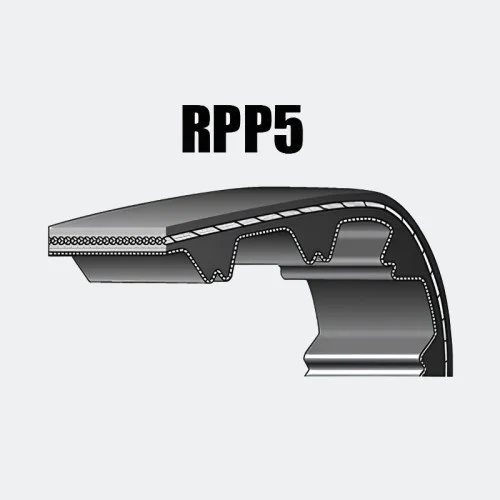
The RPP profile is developed as a parabolic tooth shape with a progressive pressure angle from the tooth root up to the tooth tip. This design gives a taller tooth at the same pitch length and reduces interference between the belt and pulley, especially when the drive is subjected to torque peaks. The tooth shape improves resistance to tooth skipping and tooth cutting, while also being able to transmit higher torque with less preload than older or simpler tooth profiles. There is a groove on the tooth tip, which makes the engagement more elastic. The groove helps the tooth to settle more evenly in the pulley groove and distributes the load more evenly between the teeth working simultaneously.
The RPP5 profile is a technical intermediate step between the very small and the larger RPP profiles. It offers more load capacity than the RPP3, but can still be used in relatively compact drives. Megadyne's RPP profile is designed to work in existing deep profile pulleys according to ISO 13050. This provides a high degree of compatibility in drives where the profile pulleys already follow this type of geometry. The positive tooth contact makes the belt suitable for precise synchronization, because the speed follows the number of teeth of the pulleys and does not depend on friction alone. In correctly dimensioned drives, MEGASYNC rubber timing belts can work at linear speeds of up to 30 m/s, making the series useful in both slower power transmission and faster machine movements.
Operating characteristics
The technical strength of the RPP 5M lies in the combination of precise tooth pitch, low noise level and high efficiency. The belt operates without the need for external lubrication, and the treated nylon surface of the teeth contributes to a lower level of friction in the contact zone. This makes the belt drive cleaner than chain drives and at the same time reduces maintenance. The synchronous movement means that the drive can maintain a constant angular velocity between the shafts when the pulley and belt are correctly designed as a system. The RPP tooth shape also helps to handle load peaks because the tooth engagement occurs gradually and not as a hard edge engagement.
The belt type is used in many forms of industrial power transmission, including where chains or sprockets are to be replaced by a lighter and quieter solution without lubrication. Machines with moderate loads and the need for smooth, uniform running are typical examples of operation where the smooth engagement of the RPP profile and good resistance to tooth skipping are of practical importance. The standard version of the belt has medium resistance to water, grease and common environmental influences, low resistance to oil and mineral oil and no real resistance to acids, bases, solvents or fuels. The normal temperature range is -25 °C to +80 °C, with short-term peak loads up to +100 °C. The hardness of standard RPP belts is 74 ±4 ShA.
Installation and maintenance
An RPP timing belt works best when the pulleys, center distance and belt tension match the load in the drive. Too low a belt tension can lead to the risk of tooth skipping during torque peaks, while too high a tension can increase noise, heat generation and load on bearings. The ability of the RPP profile to work with lower preload is an advantage because it can reduce mechanical stress in the drive. The condition of the pulleys also has an impact on the service life. Worn or rough tooth grooves can increase friction and wear the nylon fabric faster, while correct alignment between the shafts provides a more uniform load across the width of the belt. The endless construction usually does not require any post-treatment of the belt itself during operation.
Technical questions about RPP 5M
What operating environments is RPP rubber suitable for?
The standard version has medium resistance to water, grease and general environmental influences and low resistance to mineral oil and grease. It is not intended as a chemical resistant belt against acids, bases, solvents or fuels. The temperature range is from -25 °C to +80 °C with short-term peak loads up to +100 °C.
Why are endless timing belts used?
An endless timing belt has no joints in the tension layer. This provides a uniform structure all the way around, which is an advantage in rotary drives where the belt constantly passes the pulleys under load. The fixed pitch length also makes the belt suitable for precise synchronous movements.
What does pitch length mean?
The pitch length is the length of the belt measured along the theoretical pitch line in the tension layer. For an RPP belt, this length is the key identification along with the pitch, number of teeth and width. When the length is given in millimeters, the number of teeth corresponds to the length divided by the pitch.
What does the RPP profile mean?
The RPP profile is a parabolic tooth shape with a progressive pressure angle from the tooth root to the tooth tip. This shape gives a taller tooth at the same tooth pitch and a more controlled engagement in the pulley. In practice, this means that the belt can transmit torque with lower noise and better resistance to tooth skipping than a simpler tooth shape in the same type of application.
What distinguishes RPP5 from a regular tooth profile?
The RPP5 profile has a rounder and more parabolic tooth shape than classic trapezoidal profiles. The softer tooth geometry provides a more gradual load in the engagement and contributes to lower noise, less wear and better safety against tooth jump-over at load peaks.
Overall rating of the product
The Megadyne MEGASYNC 225 RPP 5M rubber timing belt combines the key features of a modern RPP rubber timing belt: endless construction, fiberglass traction, nylon weave on the teeth, parabolic profile and synchronous power transmission without lubrication. The product's length of 225 mm and 45 teeth make it a specific variant in the MEGASYNC program, while the RPP 5M profile indicates the tooth pitch and profile geometry. The strength of the belt lies in the interaction between profile, materials and endless construction, which together provide a precise and reliable timing belt drive.