New


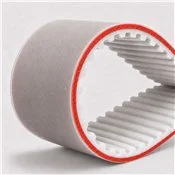
Sandwich coating ( PU Blue 65 + Sylomer Blue) combines a resilient Sylomer layer with a thinner protective top layer. The purpose is to maintain the soft and compressible contact of the foam, while protecting the foam from direct wear, puncture and crumbling. It provides a cleaner contact surface and can significantly extend the service interval in many applications compared to unprotected foam.
The structure is particularly suitable for bottles, labeling machines, feeding, positioning, fixing and other transport tasks where the workpiece must be supported softly and uniformly.
Bare foam is very resilient, but over time it can develop surface damage, become perforated or start to crumble. The sandwich construction provides a continuous wear surface over the foam. The product therefore meets the top layer, while the Sylomer layer can still be compressed and accommodate minor height differences.
PU top layer is the obvious choice when high abrasion resistance and a robust contact surface are highly valued. PU typically withstands repeated product contact and mechanical wear better than silicone, but provides slightly less grip in many dry applications.
A two-layer coating cannot be accurately described with a single thickness factor. The configurator therefore uses a practical calculation rule based on the diameter factors already used on FEC Consulting's single coatings:
Indicative coating Ø ≈ (10 × Sylomer thickness) + (25 × topcoat thickness).
The result is rounded up to the nearest practical pulley size. The model is deliberately suitable for slow and normally loaded transport tasks: the soft foam deforms around the pulley and can therefore often work on a smaller diameter than a solid coating with the same total thickness. At high speed, many bends per minute, large belt width or high load, a larger diameter should be chosen.
Practical control: 5 mm blue or green Sylomer with 1.6 mm PU gives, depending on the model, approx. Ø 90 mm. A practical starting pu will therefore typically be around Ø 100 mm in a moderate transport application.
The minimum diameter applies to the coating. The selected tooth profile, belt type, reinforcement and width may require a larger pulley. Always use the largest requirement.
Top layer and Sylomer are selected separately. Next to each thickness is a Island contribution. Add the two contributions together and round up to the nearest relevant pulley size. Sylomer also shows whether the thickness is standard or ground.
The tooth profile must match the existing timing belt pulleys. Width and length are entered in mm. PAZ nylon fabric and steel cord or aramid/Kevlar are selected separately, where the specific belt type can be manufactured as such. The final design is technically checked before production.
Not necessarily. The top layer increases the bending resistance, and therefore its diameter contribution is added to the contribution of the Sylomer layer.
Because speed, load, belt width, tooth profile, joint type, reinforcement and temperature affect the service life. The calculation is a configurator tool and not a manufacturer's warranty.
Select tooth profile, top layer thickness, Sylomer thickness, nylon weave and reinforcement, and enter belt width and length. Please provide pulley diameter, speed, load and the item being transported.