New
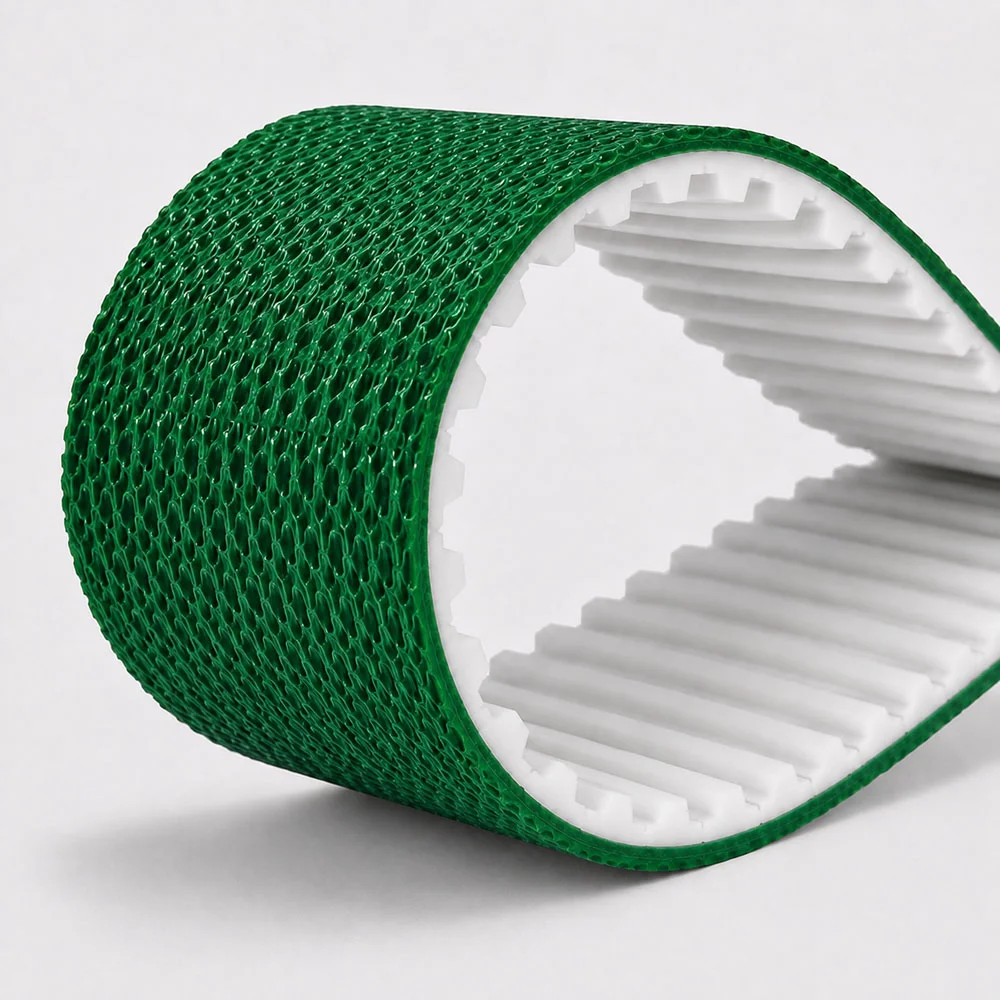

PVC Minigrip T7 is a coating for custom-made timing belts. This product type is also referred to as coated timing belts, timing belts with coating, coated timing belts and timing belt with coating. The purpose is to combine the precise synchronous movement of the timing belt with an upper surface that is adapted to the item to be transported, positioned or handled. At FEC Consulting, we specify and deliver the finished solution based on tooth profile, belt length, width, coating type and the actual operating conditions.
This variant belongs to the group PVC coatingThe material is PVC, the color is Green, and the surface is Minigrip embossing. It is typically used for feeding and positioning, where the profiled surface must provide a defined contact and a clear mechanical grip against the workpiece. The choice should always be pu on both the workpiece and the machine: weight, temperature, speed, pulley diameter, cleaning, oil or chemicals and desired friction can all have an impact on the final design.
This coating has a profiled or patterned surface. The standard thickness is 2–3mm. We therefore do not offer standard honed thickness options on the product side, because honing from the top side will reduce or remove the pattern that gives the coating its function. If a different overall structure is required, it must be considered as a custom solution.
For this coating, the diameter factor is given as 30. The recommended minimum diameter for the coating itself is calculated as the coating thickness multiplied by the diameter factor. The drop-down menu therefore shows the minimum diameter directly next to each thickness selection, for example: 2–3 mm – min. pulley diameter 60–90 mmThis makes it easier to see the consequences of a thicker or thinner selection before you submit the request.
The minimum diameter in the dropdown applies to the coating. The selected timing belt may itself have a larger minimum requirement due to tooth profile, reinforcement, belt width or construction. The correct solution must therefore always use the largest of the relevant minimum requirements. If, for example, the coating allows a smaller diameter than the base belt, the requirements of the base belt are decisive. If the thick coating requires a larger diameter, the coating is the dimensioning factor.
The tooth profile must match the existing pulleys. In the product dropdown you can choose between the relevant T, AT, HTD, RPP, STD , EAGLE and special profiles. XL and L are inch profiles for timing belts and should not be confused with PU flat belts. P1, P2 and P4 are the distinct PU flat belt types in the configurator. If the desired tooth profile is not listed, you can select OTHER TYPE and provide marking, drawing or existing belt data.
The width and length are entered in millimeters. PAZ means nylon fabric on the tooth side and can be relevant when a different contact against the pulley or a special wear surface is desired. The reinforcement is selected separately. Steel cord is the normal starting pu on many PU timing belts, while aramid/Kevlar can be relevant in certain designs. Not all combinations can necessarily be produced in all profiles and lengths, so the choices are used as a basis for the technical assessment.
PVC Minigrip T7 is relevant for conveying and positioning, where the profiled surface must provide a defined contact and a clear mechanical grip against the workpiece. A coated timing belt functions both as a positioning element and as a contact surface against the product. Therefore, one should not choose based on hardness or color alone. Two materials with the same Shore hardness can behave differently depending on surface structure, temperature, workpiece material and whether the surface is dry, moist or affected by dust and process residues. If grip is critical, a test or a concrete assessment of the application is often better than assuming a specific friction value.
On this type, the dropdown only shows the documented standard dimensions because the surface or material is not suitable for general grinding to arbitrary intermediate thicknesses.
Because the coating thickness affects how hard the belt has to bend. The minimum diameter makes it possible to quickly check whether there is room for the selected structure in the machine.
This variant is not offered with regular sanded thicknesses in the dropdown. On patterned and special materials we want to preserve the original surface and function.
Select tooth profile, coating thickness, nylon weave and reinforcement, and enter the belt width and length. Please indicate what the belt is transporting, temperature, speed, pulley diameter and any requirements for cleaning, food contact, milling, vacuum holes or other processing. A picture or drawing makes it easier to check the solution.