DISCOUNTED


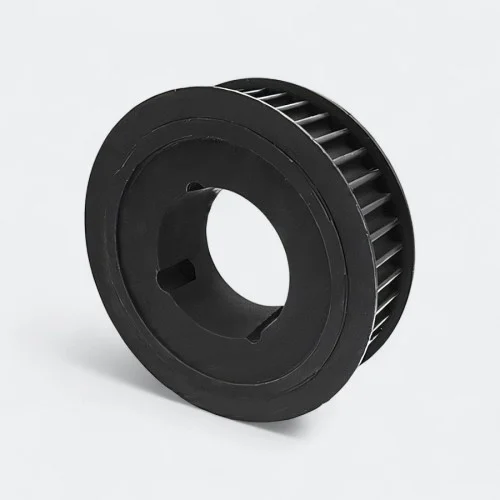
This timing belt pulley is chosen for precise HTD belt drives, where the belt must run stably and where the hub must be securely mounted on the shaft with a taper bushing. This model has 32 teeth, HTD 14M profile with 14 mm tooth pitch, belt width 40 mm and fits taper bushing 2012. The shaft range depends on the selected taper bushing, and for this bushing type it ranges from Ø12 mm to Ø50 mm. It is typically used in conveyors, packaging machines, special machines, automatic units and other V-beltless timing belt drives, where there must be no slip between the belt and the pulley.
The product is built according to the dimensions that apply to this specific size. The outer diameter of the gear pulley is Ø139.89 mm, the pitch diameter is Ø142.60 mm, and the total width b is 54 mm. The L dimension is 32 mm, and the R dimension is 11 mm. The outer diameter of the flange/plate is Ø154 mm. ND is not stated as a separate hub diameter for this variant. The inner diameter Di is Ø108 mm. The design is 18F, and the material is phosphated steel.
The taper solution makes it easier to center the pulley on the shaft, because the bushing tightens conically and distributes the clamping force around the shaft. For this timing belt pulley, taper bushing 2012 must be used. This does not mean that the pulley is supplied with a fixed bore in the hub itself. In practice, the taper bushing is selected with the bore that fits the shaft, and the bushing is then mounted in the conical seat of the pulley. For bushing 2012, the relevant shaft range is Ø12-50 mm. For example, if the shaft has a diameter within this range, the right bushing can be selected for the shaft, while timing belt pulley itself remains the same standard pulley.
It is important to distinguish between the pulley's taper bushing type and the final diameter of the shaft. The taper bushing 2012 tells you which physical bushing fits in the pulley, while the bore in the bushing tells you which shaft it fits on. When ordering, you should therefore check both: the timing belt pulley's taper-lock type and the desired shaft diameter. If the taper bushing is chosen incorrectly, the pulley cannot be mounted correctly, even if the number of teeth and belt width match.
HTD 14M is a heavy-duty metric tooth profile, typically used in larger belt drives where higher torques must be transmitted with a good engagement surface between the belt and the pulley. This pulley has 32 teeth, and this controls both the diameter and the ratio of the belt that must run in engagement with the pulley. The relatively small number of teeth results in a compact pulley, which is suitable where space in the construction is limited. The belt width is 40 mm, and the pulley must therefore be used in conjunction with a timing belt of the same width or a solution where the selected belt width is technically matched to the pulley's grooves and flanges.
If you are replacing an older pulley, it is not enough to simply measure the outside diameter. The HTD profile, tooth pitch, number of teeth and belt width must match the belt. An HTD 14M pulley must be used with a belt of the same profile because the tooth shape is designed to engage the semi-circular teeth of the belt. An incorrect profile can cause noise, faster wear, poor engagement surface or, in the worst case, a belt drive that skips teeth under load.
The pulley is made as 18F, which means it has a flange/plate to help the belt stay in place during operation. In technical drawings, it is especially b, L and R that cause confusion because they describe different width and hub dimensions. On this model, the b dimension is 54 mm, the L dimension is 32 mm and the R dimension is 11 mm. Use these dimensions together with the outer diameter Ø139.89 mm and the pitch diameter Ø142.60 mm when comparing the pulley to an existing drawing or an existing pulley.
This is especially important if the product is to replace an existing pulley where the old pulley already has defined center distance and belt type. If your current timing belt pulley has a flange, you should also check if the new pulley is an F-design. For this variant, the design is 18F. The flange diameter is Ø154 mm. Flanges can help with belt guidance, but they must not replace correct alignment of shafts and pulleys.
The material is phosphated steel. Phosphated steel provides a wear-resistant surface and is suitable for many normal machine tasks where the timing belt pulley must be able to withstand repeated operation. The phosphating gives a dark, technical surface, which also makes it easier to distinguish these tapered pulleys from standard aluminum pulleys. The choice of material has an impact on both strength, wear, weight and robustness of the construction. It is therefore important information when the pulley is to be used in an industrial belt drive and not just as a loose spare part.
With a larger number of teeth and larger profiles, the choice of material becomes extra important because the diameter, the torque of the belt drive and the load on the hub increase. This specific size must therefore be assessed together with the rest of the belt drive: motor power, speed, belt type, center distance, shaft diameter and operating environment. The pulley itself is a standardized component, but it only works optimally when it is selected together with the right belt and the right taper bushing.
Before splice, the axle, bushing and hub should be cleaned so that the contact surfaces are free of dirt, bars and old residues. The tapered bushing 2012 is placed in the pulley's tapered bearing and the screws are tightened gradually and evenly so that the bushing retracts correctly. The selected bushing must have a bore that matches the axle, and the axle should normally have a suitable fit and groove if the design requires it. Overtightening or skewed splice can cause play, poor centering or unnecessary stress on the bearings.
Once the pulley is mounted, the belt tension should be checked according to the machine's requirements. A timing belt must not be too loose or too tight. Too low a tension can cause tooth skipping and imprecise operation, while too high a tension can cause unnecessary strain on bearings, shafts and the belt. Also check that the belt runs straight in the groove and that the pulleys are parallel. Even a correctly selected timing belt pulley can cause problems if the alignment is not correct.
This pulley fits taper bushing 2012. This is the bushing type to be used in the tapered hub of the pulley. Then choose a bushing with the bore that fits the axle. For this type, the axle range is from Ø12 mm to Ø50 mm.
The pulley is designed for a HTD 14M timing belt with a belt width of 40 mm. The belt width is important because the flanges, grooves and b-dimensions are made for this width. If a different width is used, it should only be done if the entire belt drive has been technically checked.
The design is 18F. The pulley is designed as 18F, which means it has a flange/plate to help the belt stay in place during operation. Always check this against the old pulley or the machine drawing, especially if the belt is in a vertical or side-loaded position.
Always check five things before ordering: the HTD profile, the number of teeth, the belt width, the taper bushing number and the shaft diameter. For this model, the combination is HTD 14M, 32 teeth, 40 mm belt width and taper bushing 2012. The shaft range with the correct bushing is Ø12-50 mm. If this information matches the machine, you are much closer to a safe spare part without ordering the wrong part.
If you have an old pulley in hand, you can also compare the outer diameter Ø139.89 mm, pitch diameter Ø142.60 mm and b-dimension 54 mm. These measurements help ensure that the pulley not only fits the belt and shaft, but also the physical space in the machine. If in doubt, it is an advantage to send pictures or measurements so that the profile, belt width and taper bushing can be assessed before the order is placed.