New
DISCOUNTED


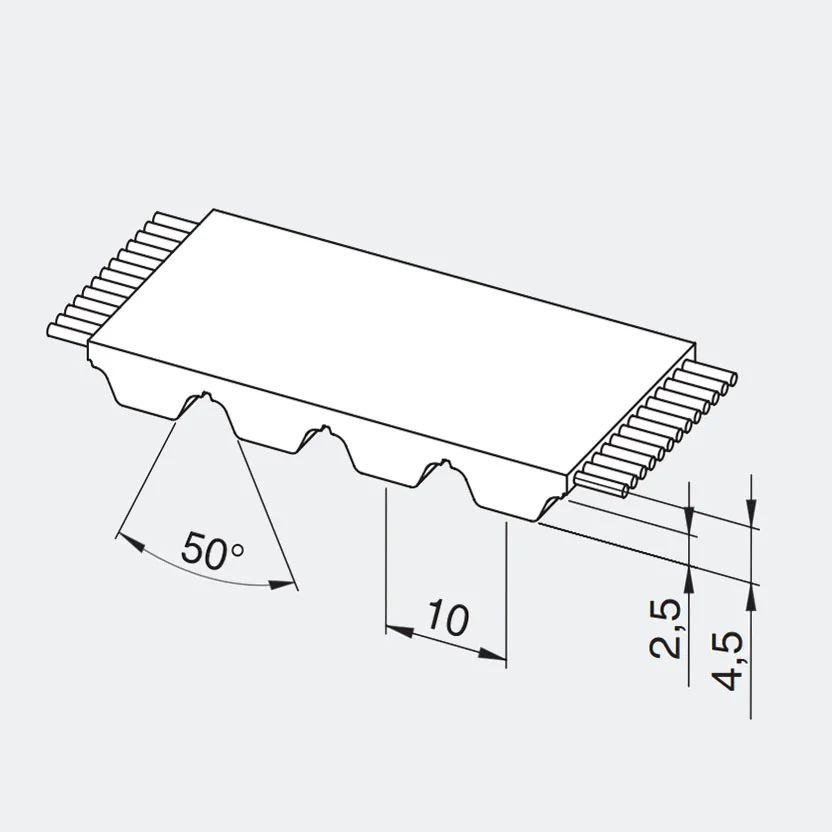




With 88 teeth distributed over a pitch length of 880 mm, the Conti Synchroflex AT10 GEN III 880 is designed for precise transmission of rotation, stroke and position. The belt is cast endlessly in PU and has integrated steel cord tension elements that stabilize the length during normal operation. The nominal tooth pitch is 10 mm and the tooth profile must match the profile of the pulleys precisely. It is not sufficient for another belt to have approximately the same length or width. The GEN III version is the reinforced high-performance construction with red high-performance polyurethane and denser, two-filament steel cord. It should therefore be treated as a separate product series and not as the usual standard version.
The technical data below describes the part of the product that does not change when a different belt width is selected. Pitch length, tooth pitch and number of teeth remain identical for all width choices. However, the width affects the available belt cross-section width and the price calculated on the product page. Correct sizing must always take into account torque, speed, number of teeth in mesh, pulley diameters, service factor and any counter-bending.
The metric AT geometry has trapezoidal teeth with a larger tooth volume than the standard T profile. The purpose is to distribute the load advantageously in the tooth mesh and achieve higher tooth strength without making the drive unnecessarily large. The profile requires suitable AT timing belt pulleys with the same pitch; a visual similarity to other profiles is not evidence of compatibility.
Conti Synchroflex is manufactured by casting, where the polyurethane is precisely shaped to the tool's tooth geometry around the embedded steel cord tension elements. The casting process provides high pitch accuracy over the entire circumference of the belt and a strong connection between PU and cord. The finished timing belt is endless and therefore has no welded joints. The polyurethane provides a wear-resistant tooth and back surface, while the steel cord takes the longitudinal tensile load.
The red GEN III construction is not just a color variant. It is developed with higher cord density and a special steel cord construction that provides increased tensile strength, better grooveing and the ability to carry higher loads. The catalog also specifies a temperature range up to +100 °C. Standard and GEN III must therefore be created and selected as separate products, even when the length and profile are the same.
The 88 teeth of the product provide a convenient length check. Multiplying the number of teeth by 10 mm gives a pitch length of 880 mm. If an existing belt has a different number of teeth, it is not the same size, even though it may look almost the same length. Also check that the teeth of the pulleys match the AT10 GEN III; the same pitch number alone is not always sufficient.
The profile series is used in practice for tasks such as construction machinery, pu , paper machines, compressors, compactors, textile machines and roller conveyor drives. Common to these machines is the need for a fixed transmission ratio and controlled tooth engagement. A timing belt can transmit both force and position, but the capacity cannot be assessed based on length alone. Width, profile version, wrap angle and load cycle are among the data that must be included in the selection.
This product line has been created with 16 mm as the base width because this is the width of the selected item and thus the SKU used for inventory control. Integer widths from 16 to 50 mm can be selected on this product page. The widths that appear as standard widths in the supplier data are marked separately in the options. The price surcharge is calculated as a percentage of the base width: doubling the width results in a surcharge of 100%. The technically necessary width should be selected according to the load and not only according to the price.
The number of teeth on the pulleys affects both the gear ratio, deflection and how many belt teeth carry the load. A small pulley may be necessary in a compact drive, but it should not be selected without considering the minimum profile requirements and any counter deflection. Use timing belt pulleys with 10 mm pitch and the correct AT10 GEN III tooth shape, and check that the flanges do not damage the belt edge.
When installing, the cord pullers must be protected against kinks and local pressure damage. The belt must not be pinched with pliers or a screwdriver, and it should not be folded sharply. Check that the pulleys have the same pitch and profile as the belt and that they are not worn out. A stable drive is achieved through the right combination of alignment, wrapping and calculated pretension.
Continental specifies a temperature range of up to +100 °C for the GEN III series. When operating close to the temperature limits, the drive must still be dimensioned according to the specific load and environmental conditions. The service life is not only affected by the material, but also by load peaks, bending, pulley size, alignment and surroundings. Keep the drive clean and do not remove deposits with sharp tools that could damage the teeth. If the belt is operating in chemically exposed areas, food environments, clean rooms or at extreme temperatures, a suitable special design should be considered.
A properly running timing belt should move smoothly without continuous contact against one flange. Regularly check the teeth for deformation, the back for ctiming bars and the edges for frayed areas. Abnormal noise or heat can be an early sign of incorrect tension or pulley failure. A systematic check of pulleys and belt is more effective than trying to hide symptoms with lubricant.
No. The Conti Synchroflex series is manufactured as cast, endless timing belts. The belt therefore does not have a welded joint around the circumference. The cast process provides a uniform tooth pitch around the entire belt and a strong bond between the polyurethane and the cast steel cord tension elements.
Store the belt in a dry, clean place away from direct sunlight, ozone, strong heat or chemical fumes. It should be free from sharp bends and without heavy loads on top. Avoid hanging a small belt over a sharp hook as this can cause local deformation.
The Conti Synchroflex series is designed for precise and fast synchronous drives, but the permissible speed depends on the profile, pulley diameter, belt width, load and peripheral speed. A high speed must therefore not be approved based on the product name alone; the drive must be calculated.
Correct pretension keeps the teeth in stable engagement and reduces the risk of tooth jump. Too low a tension can cause impact and jump under load, while too high a tension increases the load on the cord, pulleys and bearings. The correct value must be determined based on the drive's dimensioning.
The documented supplier widths for this size include 16, 20, 25, 32 and 50 mm. The product page may also show intermediate sizes as cut widths when they are within the allowed range. This does not change the tooth profile or length, but the price is calculated based on the base width.
Check that the belt runs centrally, that there is no abnormal heat or noise, and that the edges are not constantly rubbing against the flanges. Also look for signs of too low or too high pretension. If the drive requires a re-tension check, the machine manufacturer's procedure must be followed.
The tooth engagement provides a positive, synchronous transmission without the normal slippage of a friction belt. This makes the profile relevant for positioning tasks, but the achievable accuracy also depends on the quality of the pulleys, shaft play, belt pretension, load and the overall machine design.
In summary, this is a Conti Synchroflex PU timing belt with a fixed geometry of 10 mm pitch, 88 teeth and 880 mm pitch length. The width is selected separately, but does not change the length or number of teeth. A safe replacement requires that the entire designation and the specific version match the machine documentation.