New
DISCOUNTED






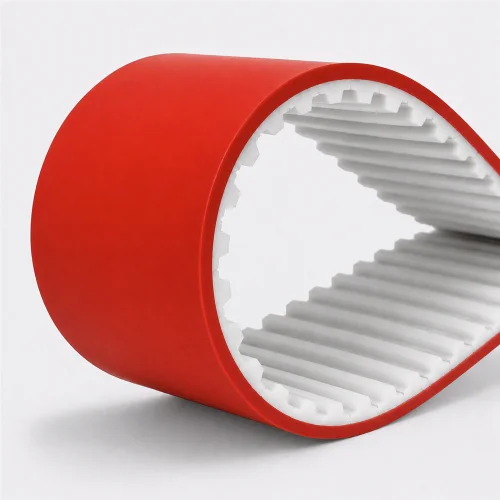
This AT5 GEN III timing belt is specified with a pitch length of 670 mm and 134 teeth. The ratio between length and number of teeth is fixed: 670 mm divided by 5 mm gives exactly 134 teeth. The Conti Synchroflex AT5 GEN III 670 is supplied as a cast, endless PU belt, so that there is no weld joint in the finished ring. The design is developed for synchronous operation and precise machine movements. The GEN III version is the reinforced high-performance design with red high-performance polyurethane and a denser, two-filament steel cord. It should therefore be treated as a separate product series and not as the regular standard version.
The technical data below describes the part of the product that does not change when a different belt width is selected. Pitch length, tooth pitch and number of teeth remain identical for all width choices. However, the width affects the available belt cross-section width and the price calculated on the product page. Correct sizing must always take into account torque, speed, number of teeth in mesh, pulley diameters, service factor and any counter-bending.
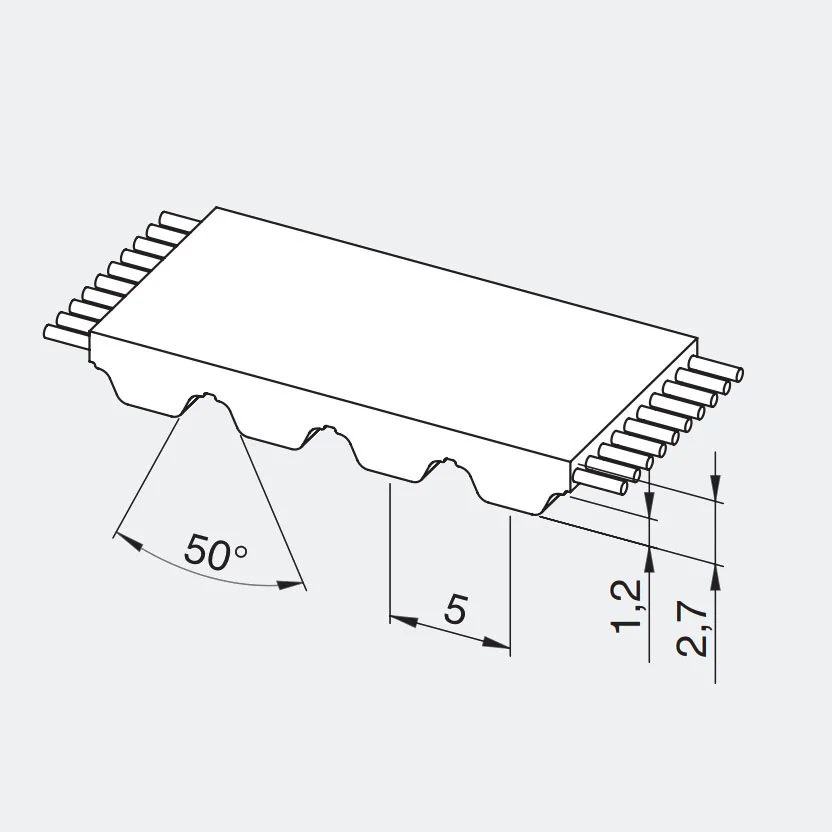
The AT profile has been further developed from the classic T profile. The larger tooth volume provides a higher tooth shear strength, and the profile is designed for a favorable tooth engagement with reduced engagement shocks. This makes the AT series suitable when a drive must be compact and at the same time transmit motion precisely. Continental states that the AT profile can perform up to 50% more than a corresponding T profile, but the actual capacity always depends on width, discs, speed and load profile.
With the cast manufacturing method, the finished belt becomes an exact copy of a precision-machined shape. This is a major reason for the uniform tooth pitch and reproducible length. The steel cord is integrated into the polyurethane and contributes to position and angular precision. The design is suitable for synchronous drives, where a conventional elastic friction belt does not provide the desired repeatability.
The red GEN III construction is not just a color variant. It is developed with higher cord density and a special steel cord construction that provides increased tensile strength, better grooveing and the ability to carry higher loads. The catalog also specifies a temperature range up to +100 °C. Standard and GEN III must therefore be created and selected as separate products, even when the length and profile are the same.
This product line has been created with 6 mm as the base width because this is the width of the selected item and thus the SKU used for inventory control. Integer widths from 6 to 50 mm can be selected on this product page. The widths that appear as standard widths in the supplier data are marked separately in the options. The price surcharge is calculated as a percentage of the base width: doubling the width results in a surcharge of 100%. The technically necessary width should be selected according to the load and not only according to the price.
The profile series is used in practice for tasks such as machine tools, pu , textile machines and positioning and conveying systems. Common to these machines is the need for a fixed transmission ratio and controlled tooth engagement. A timing belt can transmit both force and position, but the capacity cannot be assessed based on length alone. Width, profile version, wrap angle and load cycle are among the data that must be included in the selection.
The product's 134 teeth provide a convenient length check. Multiplying the number of teeth by 5 mm gives a pitch length of 670 mm. If an existing belt has a different number of teeth, it is not the same size, even though it may look almost the same length. Also check that the teeth on the pulleys match AT5 GEN III; the same pitch number alone is not always sufficient.
The tooth profile of the timing belt pulleys must correspond to the AT5 GEN III of the belt, and their pitch must be 5 mm. The transmission ratio is determined by the ratio of the number of teeth of the pulleys, not by the width of the belt. A larger pulley usually reduces the bending load, while a very small pulley gives more bending per revolution. The angle of engagement and the number of teeth in mesh must be sufficient for the current load.
When installing, the cord pullers must be protected against kinks and local pressure damage. The belt must not be pinched with pliers or a screwdriver, and it should not be folded sharply. Check that the pulleys have the same pitch and profile as the belt and that they are not worn out. A stable drive is achieved through the right combination of alignment, wrapping and calculated pretension.
Uniform light polishing of the tooth flanks may be normal, but localised spalling, ctiming baring or severe wear should be investigated. Wear on one edge often indicates misalignment or persistent flange contact. Damage to tooth tips may be due to incorrect profile, foreign bodies or inadequate engagement. If cord becomes visible or the belt has a sharp break, it should not continue in service without assessment.
Continental specifies a temperature range of up to +100 °C for the GEN III series. When operating close to the temperature limits, the drive must still be dimensioned according to the specific load and environmental conditions. The timing belt operates without lubrication, and oil or grease should therefore not be added to dampen noise. The polyurethane is described as resistant to aging as well as simple oils, grease and petrol and to certain acids and bases. In the case of permanent contact, cleaning chemicals or unknown media, material compatibility should be specifically clarified.
The steel cord tension members absorb the longitudinal tensile load and provide high longitudinal stiffness. This helps maintain pitch and position during operation. The cord must not be kinked, exposed or damaged during installation, as local damage can weaken the belt.
Store the belt in a dry, clean place away from direct sunlight, ozone, strong heat or chemical fumes. It should be free from sharp bends and without heavy loads on top. Avoid hanging a small belt over a sharp hook as this can cause local deformation.
The tooth pitch is the distance from one tooth to the next and is 5 mm for this profile. The pitch length is the entire nominal circumference in the cord line and is 670 mm. When the pitch length is divided by the tooth pitch, the belt has 134 teeth.
Yes, the belt width can usually be measured directly on the flat back or between clean, undamaged edges. However, the width is only one part of the identification. The profile, pitch length, number of teeth and any DL or GEN III version must also be correct.
No. The Conti Synchroflex series is manufactured as cast, endless timing belts. The belt therefore does not have a welded joint around the circumference. The cast process provides a uniform tooth pitch around the entire belt and a strong bond between the polyurethane and the cast steel cord tension elements.
6 mm is the width of the supplier item whose SKU is used as the main product's stock reference. Other widths are handled as choices under the same product because they are cut from the same type of timing belt sleeve. The base width also determines the percentage-based pricing in the webshop.
This should be avoided. The belt should be installed by adjusting the center distance or following the correct installation procedure for the machine. Forcing it over a flange can damage the cord pullers, teeth or belt edge. After installation, the pulleys must be parallel and the pretension must be correct.
Conti Synchroflex AT5 GEN III 670 is the correct size when the drive requires AT5 GEN III, 670 mm pitch length and 134 teeth. The belt is cast endless in PU with steel cord and must be used with timing belt pulleys that match the profile. Choose the width according to the technical load and always check the design, alignment and pretension before commissioning.