Sold out
DISCOUNTED
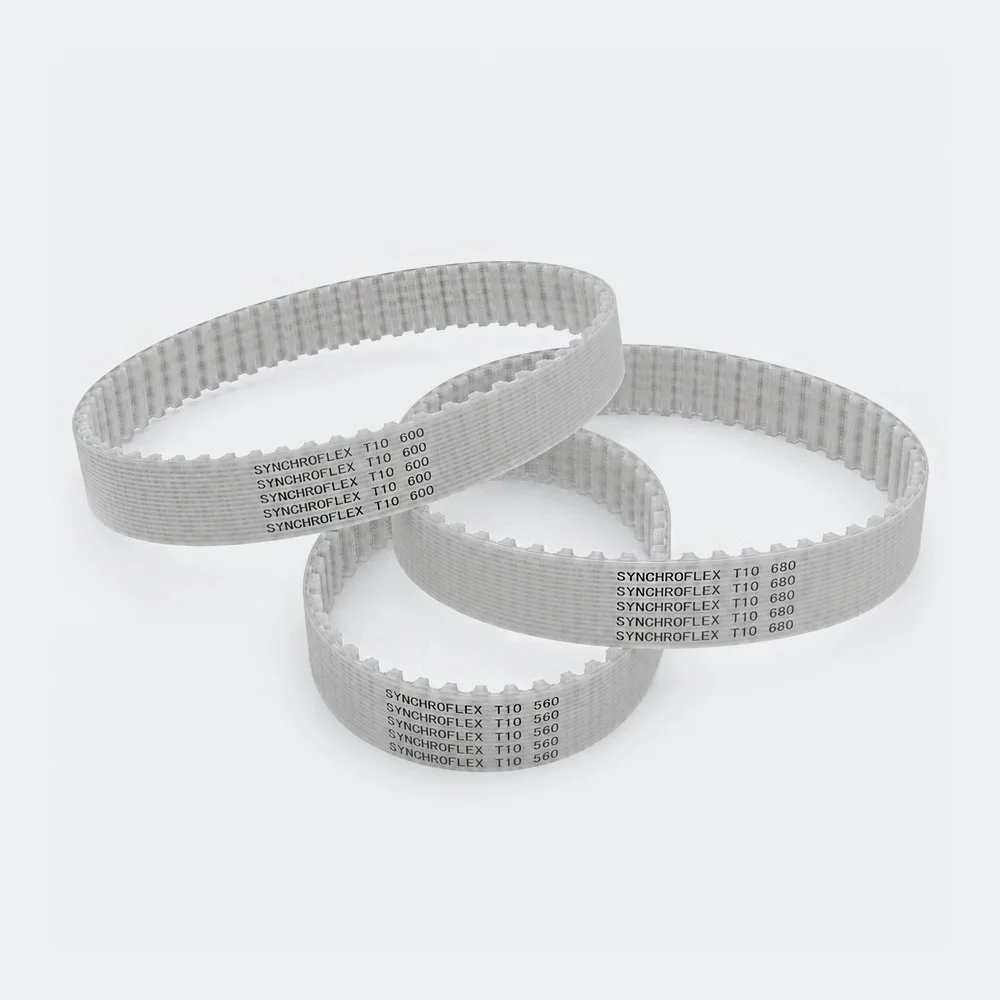


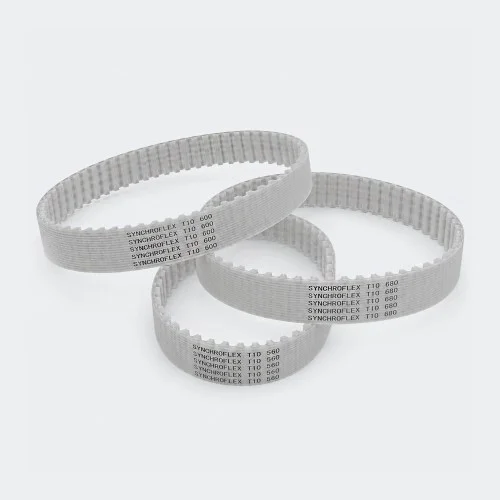
The Conti Synchroflex T10 1560 combines a precise T10 tooth geometry with a molded polyurethane body and longitudinally stable steel cord tension elements. The product has 156 teeth and a pitch length of 1560 mm, which corresponds to a tooth pitch of 10 mm. The belt is used in synchronous drives where uniform movement and reproducible position are more important than the elasticity normally associated with a conventional V-belt or flat belt. This is the standard version in the specified profile. It must not be confused with a possible GEN III version or a double-sided DL belt with the same pitch length.
The list gathers the information normally used to identify a timing belt: nominal length, number of teeth, profile, material and make. It is important to read all the information together. Two belts can have the same pitch length but be incompatible if the tooth profile or tooth pitch is different. Conversely, a different width does not change the number of teeth as long as the profile and pitch length are the same.
As a classic metric profile, the T-series is used in many machines where reliable synchronous movement is important. The tooth shape is trapezoidal, and the number in the profile designation indicates the tooth pitch in millimeters. The correct washer must therefore both have the same pitch and be manufactured for the T-profile. The wrong profile can lead to poor engagement, noise and rapid wear.
With the cast manufacturing method, the finished belt becomes an exact copy of a precision-machined shape. This is a major reason for the uniform tooth pitch and reproducible length. The steel cord is integrated into the polyurethane and contributes to position and angular precision. The design is suitable for synchronous drives, where a conventional elastic friction belt does not provide the desired repeatability.
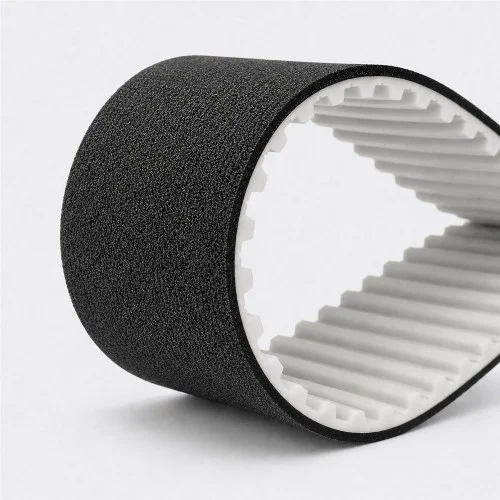
This item is a single-sided standard design. The teeth are located on the inside of the belt, while the back is smooth. It should not be confused with a double-sided DL version or the red GEN III series. If the machine is originally dimensioned for a specific variant, a change should only be made after a technical assessment of load, pulleys and preload.
The application examples in the catalogue include machine tools, main and auxiliary drives, textile machines and printing machines. This shows that the profile can be used in both power transmission and motion control. However, the specific belt must only be finally selected when the machine's torque, speed, center distance and pulley geometry are known. When simply replacing a spare part, the safest method is usually to copy the documented profile, length, design and width.
The standard material is specified for ambient temperatures from -30 °C to +80 °C. Applications close to the limits, especially below -10 °C or above +50 °C, may require special dimensioning. The timing belt operates without lubrication, and oil or grease should therefore not be added to dampen noise. The polyurethane is described as resistant to aging as well as simple oils, grease and petrol and to certain acids and bases. In the case of permanent contact, cleaning chemicals or unknown media, material compatibility should be specifically clarified.
The belt width is not written in the product name because the same pitch length is collected on one product page. The starting pu is 6 mm. Integer widths from 6 to 50 mm can be selected on this product page. The original supplier widths for this length are 6, 8, 10, 12, 16, 20, 25, 32 and 50 mm. Other intermediate sizes are offered as cut-to-size versions of the same type of timing belt sleeve when they are within the selection shown. The number of teeth, pitch length and profile do not change when the width is changed.
The tooth profile of the timing belt pulleys must correspond to the T10 of the belt, and their pitch must be 10 mm. The transmission ratio is determined by the ratio of the number of teeth of the pulleys, not by the width of the belt. A larger pulley usually reduces the bending load, while a very small pulley gives more bending per revolution. The angle of engagement and the number of teeth in mesh must be sufficient for the current load.
The belt must be able to be placed on the pulleys without force. If it can only be mounted by forcing it over a flange, the center distance or mounting procedure is incorrect. The pulley shafts must be aligned and the flanges must be smooth and undamaged. In the case of multi-shaft or counter-bent drives, the diameter and position of the rollers must be assessed separately. Correct pretensioning reduces the risk of tooth skipping without unnecessarily loading the bearings.
Uniform light polishing of the tooth flanks may be normal, but localised spalling, ctiming baring or severe wear should be investigated. Wear on one edge often indicates misalignment or persistent flange contact. Damage to tooth tips may be due to incorrect profile, foreign bodies or inadequate engagement. If cord becomes visible or the belt has a sharp break, it should not continue in service without assessment.
It is not enough to compare the total circumference of a belt. The correct replacement must have the same pitch, tooth profile and number of teeth as the existing drive. The width must match the pulleys and the required capacity, and a DL or GEN III version must be identified separately. If in doubt, pictures of the marking, tooth profile and pulleys can be used as a supplement, but a documented spare part designation is best.
No. All width choices on this product page have the same pitch length of 1560 mm and the same number of teeth of 156. Only the width of the belt, and thus the price and possible load capacity, changes. The width must still match the pulleys and the technical dimensioning.
No. A timing belt requires timing belt pulleys with the correct profile and pitch, while a V-belt works by friction in V-grooves. A conversion therefore requires new pulleys and a dimensioning of the entire transmission. The product is intended as a timing belt, not as a universal replacement.
The documented supplier widths for this size include 6, 8, 10, 12, 16, 20, 25, 32 and 50 mm. The product page may also show intermediate sizes as cut widths when they are within the allowed range. This does not change the tooth profile or length, but the price is calculated based on the base width.
No. The Conti Synchroflex series is manufactured as cast, endless timing belts. The belt therefore does not have a welded joint around the circumference. The cast process provides a uniform tooth pitch around the entire belt and a strong bond between the polyurethane and the cast steel cord tension elements.
The standard PU is described as resistant to simple oils, grease and petrol as well as certain acids and bases. This does not mean universal chemical resistance. In the case of continuous contact, high concentrations or cleaning agents, the specific liquid, temperature and exposure time should be assessed.
Yes, the belt width can usually be measured directly on the flat back or between clean, undamaged edges. However, the width is only one part of the identification. The profile, pitch length, number of teeth and any DL or GEN III version must also be correct.
The Conti Synchroflex series is designed for precise and fast synchronous drives, but the permissible speed depends on the profile, pulley diameter, belt width, load and peripheral speed. A high speed must therefore not be approved based on the product name alone; the drive must be calculated.
Conti Synchroflex T10 1560 is the correct size when the drive requires T10, 1560 mm pitch length and 156 teeth. The belt is cast endless in PU with steel cord and must be used with timing belt pulleys that match the profile. Choose the width according to the technical load and always check the design, alignment and pretension before commissioning.