New
DISCOUNTED
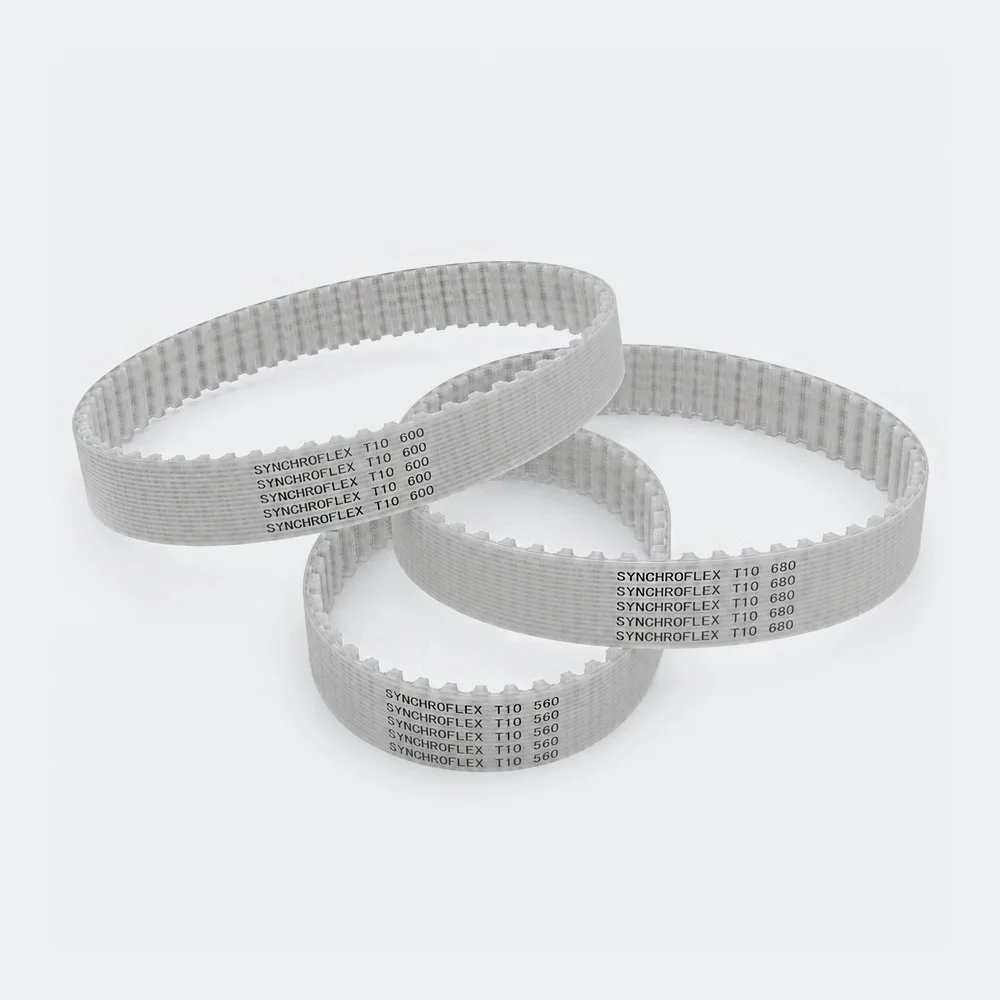


When a timing belt needs to be replaced correctly, the profile, pitch length and number of teeth are the first data that must be correct. The Conti Synchroflex T10 450 has a T10 profile, 10 mm tooth pitch, 450 mm pitch length and 45 teeth. This makes the product unique on the length and profile side, while the belt width is selected separately on the product side. The belt is manufactured as an endless Conti Synchroflex PU timing belt with steel cord. This is the standard version in the specified profile. It must not be confused with a possible GEN III version or a double-sided DL belt with the same pitch length.
The list gathers the information normally used to identify a timing belt: nominal length, number of teeth, profile, material and make. It is important to read all the information together. Two belts can have the same pitch length but be incompatible if the tooth profile or tooth pitch is different. Conversely, a different width does not change the number of teeth as long as the profile and pitch length are the same.
The T-profile is the classic metric timing belt profile with trapezoidal teeth and is described as a standard profile according to DIN 7721. It is used for general synchronous drives, positioning tasks and solutions with significant bending. The simple and proven geometry of the profile makes it widely used, but it still needs to be matched with a T-disc with the same tooth pitch. AT, HTD and other profiles are not automatically interchangeable.
The belt body consists of wear-resistant polyurethane, which encloses high-strength steel cord. The materials each have their own function: PU forms the teeth and protects the belt against mechanical wear, while the cord tensioning elements provide high longitudinal stiffness and limit post-elongation. Continental describes the design as maintenance-friendly and lubrication-free. This does not mean that the drive can be ignored; pulleys, alignment and pretension should still be checked.
The standard version is selected when the supplier's article data does not specify GEN III or DL. This is an important product distinction, because different versions can share both profile and length. Therefore, on this product page, it is the standard version that is described. The belt width can be selected, but the basic construction and tooth geometry are not changed.
This product line has been created with 6 mm as the base width because this is the width of the selected item and thus the SKU used for inventory control. Integer widths from 6 to 50 mm can be selected on this product page. The widths that appear as standard widths in the supplier data are marked separately in the options. The price surcharge is calculated as a percentage of the base width: doubling the width results in a surcharge of 100%. The technically necessary width should be selected according to the load and not only according to the price.
The profile series is used in practice for tasks such as machine tools, main and auxiliary drives, textile machines and printing machines. Common to these machines is the need for a fixed transmission ratio and controlled tooth engagement. A timing belt can transmit both force and position, but the capacity cannot be assessed based on length alone. Width, profile version, wrap angle and load cycle are among the data that must be included in the selection.
The product's 45 teeth provide a convenient length check. Multiplying the number of teeth by 10 mm gives a pitch length of 450 mm. If an existing belt has a different number of teeth, it is not the same size, even though it may look almost the same length. Also check that the teeth on the pulleys match T10; the same pitch number alone is not always sufficient.
The number of teeth on the pulleys affects both the gear ratio, deflection and how many belt teeth carry the load. A small pulley may be necessary in a compact drive, but it should not be selected without considering the minimum profile requirements and any counter deflection. Use timing belt pulleys with 10 mm pitch and the correct T10 tooth shape, and check that the flanges do not damage the belt edge.
The timing belt pulleys must be parallel and in the same plane. Even minor misalignments can cause the belt to move towards a flange and cause edge or cord damage. The belt should be installed without being twisted, sharply bent or pressed over a flange with a tool. The center distance is adjusted to achieve the calculated preload. Too high a tension increases the bearing and cord load, while too low a tension can cause tooth jumps at load peaks.
Early damage is often caused by conditions surrounding the belt rather than the material itself. Bent shafts, worn tooth grooves, foreign objects and incorrect pretensioning can all shorten the service life. In the event of a belt break, the pulleys should therefore be cleaned and inspected before the new belt is fitted. Also check whether load conditions or start-stop cycles have changed since the original design.
The standard material is specified for ambient temperatures from -30 °C to +80 °C. Applications close to the limits, especially below -10 °C or above +50 °C, may require special sizing. The service life is not only affected by the material, but also by load peaks, bending, pulley size, alignment and environment. Keep the drive clean and do not remove deposits with sharp tools that could damage the teeth. If the belt operates in chemically exposed areas, food environments, clean rooms or at extreme temperatures, a suitable special design should be considered.
No. The Conti Synchroflex series is manufactured as cast, endless timing belts. The belt therefore does not have a welded joint around the circumference. The cast process provides a uniform tooth pitch around the entire belt and a strong bond between the polyurethane and the cast steel cord tension elements.
No. The timing belt is designed for lubrication-free operation. Oil or grease should not be added to reduce noise as this may mask an alignment, pretension or worn pulley problem. Instead, keep the tooth mesh clean and check the cause of any abnormal noise.
No. A timing belt requires timing belt pulleys with the correct profile and pitch, while a V-belt works by friction in V-grooves. A conversion therefore requires new pulleys and a dimensioning of the entire transmission. The product is intended as a timing belt, not as a universal replacement.
The standard version is specified for ambient temperatures from -30 °C to +80 °C. At temperatures below -10 °C or above +50 °C, adapted sizing may be required.
The belt has 45 teeth. The number of teeth is calculated by dividing the pitch length of 450 mm by the tooth pitch of 10 mm. The result is 45, and this number can be used as an additional check when identifying an existing belt. A different number of teeth means a different pitch length.
This product is the standard version. GEN III is a separate reinforced series with red high-performance PU and denser, two-filament steel cord. The same profile and length therefore do not mean that the products are identical.
The steel cord tension members absorb the longitudinal tensile load and provide high longitudinal stiffness. This helps maintain pitch and position during operation. The cord must not be kinked, exposed or damaged during installation, as local damage can weaken the belt.
Count the teeth and check the pitch. 45 teeth times 10 mm gives 450 mm pitch length. Then compare the profile and design with the marking or the machine's spare parts list. A measurement around the outside of the belt alone is not accurate enough.
In summary, this is a Conti Synchroflex PU timing belt with a fixed geometry of 10 mm pitch, 45 teeth and 450 mm pitch length. The width is selected separately, but does not change the length or number of teeth. A safe replacement requires that the entire designation and the specific version match the machine documentation.