Sold out
DISCOUNTED
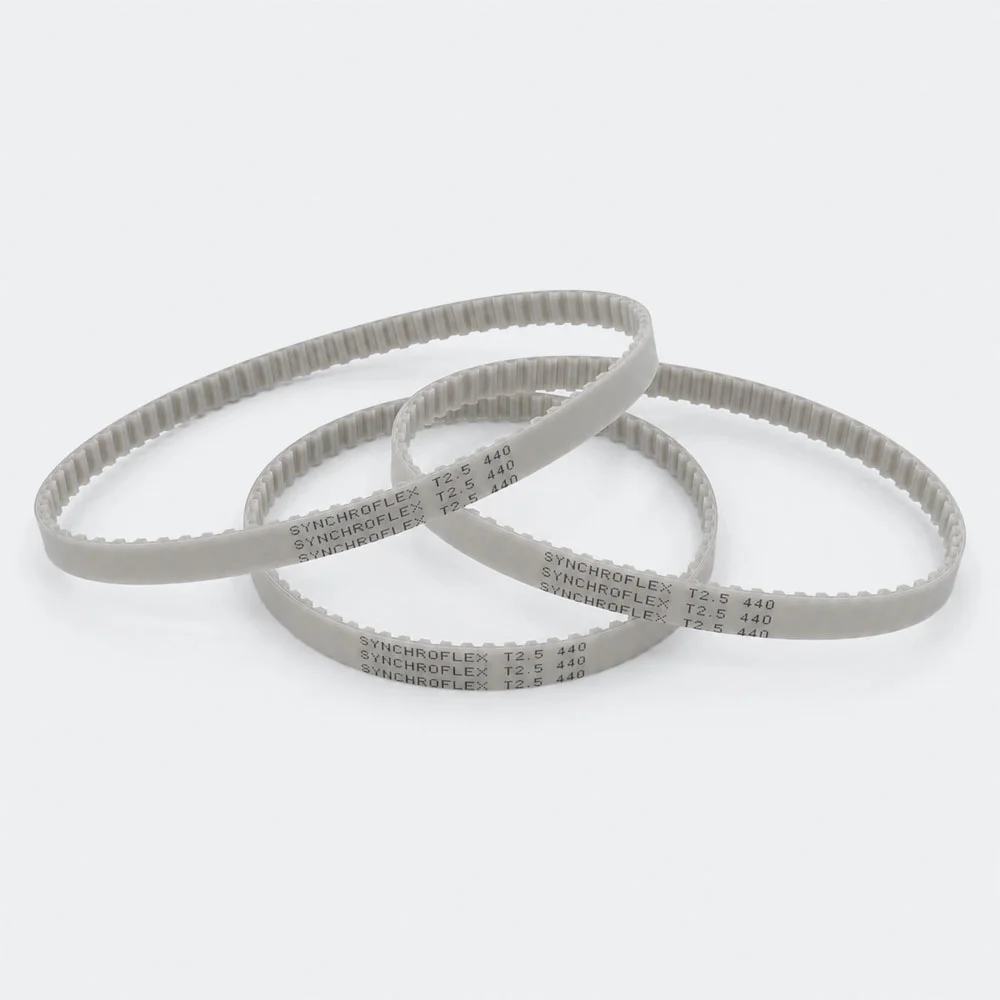


When a timing belt needs to be replaced correctly, the profile, pitch length and number of teeth are the first data that must be correct. The Conti Synchroflex T2.5 290 has a T2.5 profile, 2.5 mm tooth pitch, 290 mm pitch length and 116 teeth. This makes the product unique in terms of length and profile, while the belt width is selected separately on the product page. The belt is manufactured as an endless Conti Synchroflex PU timing belt with steel cord. This is the standard version in the specified profile. It must not be confused with a possible GEN III version or a double-sided DL belt with the same pitch length.
These specifications can be used as a check against the marking on the old belt or against the machine's spare parts list. The pitch length is not necessarily the same as a measurement across the outside of the belt, and the number of teeth is therefore often the safest additional check. If in doubt, both the belt and timing belt pulleys should be examined before ordering a replacement.
The T-profile is the classic metric timing belt profile with trapezoidal teeth and is described as a standard profile according to DIN 7721. It is used for general synchronous drives, positioning tasks and solutions with significant bending. The simple and proven geometry of the profile makes it widely used, but it still needs to be matched with a T-disc with the same tooth pitch. AT, HTD and other profiles are not automatically interchangeable.
With the cast manufacturing method, the finished belt becomes an exact copy of a precision-machined shape. This is a major reason for the uniform tooth pitch and reproducible length. The steel cord is integrated into the polyurethane and contributes to position and angular precision. The design is suitable for synchronous drives, where a conventional elastic friction belt does not provide the desired repeatability.
The standard version is selected when the supplier's article data does not specify GEN III or DL. This is an important product distinction, because different versions can share both profile and length. Therefore, on this product page, it is the standard version that is described. The belt width can be selected, but the basic construction and tooth geometry are not changed.
The product's 116 teeth provide a convenient length check. Multiplying the number of teeth by 2.5 mm gives a pitch length of 290 mm. If an existing belt has a different number of teeth, it is not the same size, even though it may look almost the same length. Also check that the teeth on the pulleys match T2.5; the same pitch number alone is not always sufficient.
The application examples in the catalogue include precision mechanics, positioning drives, small synchronous machine movements and measuring and control equipment. This shows that the profile can be used in both power transmission and motion control. However, the specific belt must only be finally selected when the machine's torque, speed, center distance and pulley geometry are known. When simply replacing a spare part, the safest method is usually to copy the documented profile, length, design and width.
The basic price applies to 4 mm, and the other widths are calculated with the same percentage logic as the existing PU timing belts in the webshop. Integer widths from 4 to 50 mm can be selected on this product page. A width of twice the basic width therefore costs 100% more, while a width of one and a half times the basic width gives approximately 50% extra. This price rule is a webshop calculation; it does not replace a technical dimensioning of the belt's load-bearing capacity.
The number of teeth on the pulleys affects both the gear ratio, deflection and how many belt teeth carry the load. A small pulley may be necessary in a compact drive, but it should not be selected without considering the minimum profile requirements and any counter deflection. Use timing belt pulleys with 2.5 mm pitch and the correct T2.5 tooth shape, and check that the flanges do not damage the belt edge.
The belt must be able to be placed on the pulleys without force. If it can only be mounted by forcing it over a flange, the center distance or mounting procedure is incorrect. The pulley shafts must be aligned and the flanges must be smooth and undamaged. In the case of multi-shaft or counter-bent drives, the diameter and position of the rollers must be assessed separately. Correct pretensioning reduces the risk of tooth skipping without unnecessarily loading the bearings.
The standard material is specified for ambient temperatures from -30 °C to +80 °C. Applications close to the limits, especially below -10 °C or above +50 °C, may require special sizing. The molded PU belt is maintenance-friendly and does not require lubricant. Regular visual inspection is still relevant: look for ctiming bars, frayed edges, shiny tooth flanks, foreign body impressions and abnormal side contact. Sudden changes in noise or grooveing may indicate misalignment, too low tension or worn pulleys.
Troubleshooting should start with pu location of the damage. Edge wear is typically associated with grooveing and alignment, while tooth skipping can be associated with too low tension, load peaks or too few teeth in mesh. Ctiming bars on the back can be caused by too small rollers, back bending or environmental influences. Do not simply replace the belt without also finding the mechanical cause.
The belt has 116 teeth. The number of teeth is calculated by dividing the pitch length of 290 mm by the tooth pitch of 2.5 mm. The result is 116, and this number can be used as an additional check when identifying an existing belt. A different number of teeth means a different pitch length.
Not necessarily. A larger width provides a more active belt cross-section and can increase the permissible load, but the drive capacity also depends on the profile, number of teeth in mesh, pulley size, speed, load factor and preload. The width should be selected by an overall calculation.
The tooth engagement provides a positive, synchronous transmission without the normal slippage of a friction belt. This makes the profile relevant for positioning tasks, but the achievable accuracy also depends on the quality of the pulleys, shaft play, belt pretension, load and the overall machine design.
4 mm is the width of the supplier item whose SKU is used as the main product's stock reference. Other widths are handled as choices under the same product because they are cut from the same type of timing belt sleeve. The base width also determines the percentage-based pricing in the webshop.
No, not without documented compatibility. The 2.5 mm tooth pitch describes the distance between the teeth, but the shape and clearance of the tooth flanks may differ. The belt must be used with pulleys manufactured to the T2.5 profile. Visual similarity is not sufficient documentation.
The standard version is specified for ambient temperatures from -30 °C to +80 °C. At temperatures below -10 °C or above +50 °C, adapted sizing may be required.
The standard version is single-sided with teeth on the inside and a smooth back. It must run with the teeth in the corresponding tooth grooves; the back is not an alternative tooth side.
This product is the standard version. GEN III is a separate reinforced series with red high-performance PU and denser, two-filament steel cord. The same profile and length therefore do not mean that the products are identical.
Conti Synchroflex T2.5 290 is the correct size when the drive requires T2.5, 290 mm pitch length and 116 teeth. The belt is cast endless in PU with steel cord and must be used with timing belt pulleys that match the profile. Choose the width according to the technical load and always check the design, alignment and pretension before commissioning.