New
DISCOUNTED


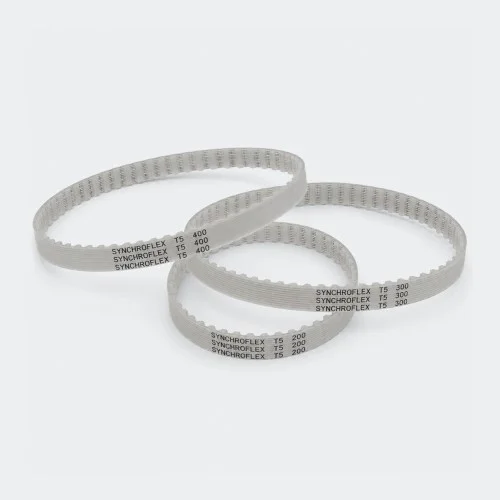
With 67 teeth distributed over a pitch length of 201 mm, the Conti Synchroflex AT3 GEN III 201 is designed for precise transmission of rotation, stroke and position. The belt is cast endlessly in PU and has integrated steel cord tension elements that stabilize the length during normal operation. The nominal tooth pitch is 3 mm and the tooth profile must match the profile of the pulleys precisely. It is not sufficient for another belt to have approximately the same length or width. The GEN III version is the reinforced high-performance construction with red high-performance polyurethane and denser, two-filament steel cord. It should therefore be treated as a separate product series and not as the usual standard version.
The list gathers the information normally used to identify a timing belt: nominal length, number of teeth, profile, material and make. It is important to read all the information together. Two belts can have the same pitch length but be incompatible if the tooth profile or tooth pitch is different. Conversely, a different width does not change the number of teeth as long as the profile and pitch length are the same.
The metric AT geometry has trapezoidal teeth with a larger tooth volume than the standard T profile. The purpose is to distribute the load advantageously in the tooth mesh and achieve higher tooth strength without making the drive unnecessarily large. The profile requires suitable AT timing belt pulleys with the same pitch; a visual similarity to other profiles is not evidence of compatibility.
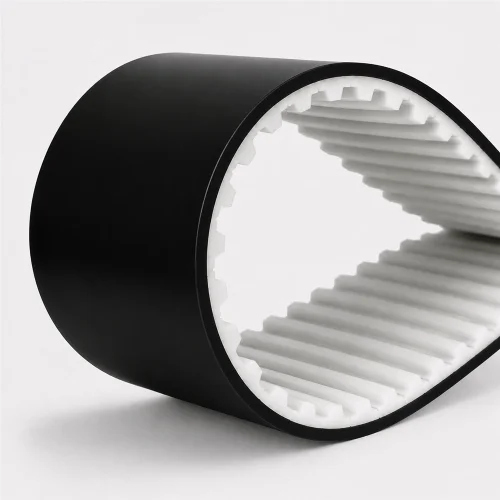
The belt body consists of wear-resistant polyurethane, which encloses high-strength steel cord. The materials each have their own function: PU forms the teeth and protects the belt against mechanical wear, while the cord tensioning elements provide high longitudinal stiffness and limit post-elongation. Continental describes the design as maintenance-friendly and lubrication-free. This does not mean that the drive can be ignored; pulleys, alignment and pretension should still be checked.
In the GEN III series, both the polyurethane and the tension body are optimized for higher performance. The tighter cord packing can increase the permissible tensile load, and the balanced two-filament construction is designed to reduce flange friction and improve belt running. Continental states that existing standard AT or ATP pulleys can be used with the corresponding GEN III profile. However, the remaining dimensioning of the drive still needs to be checked.
The application examples in the catalogue include small power drives, handling equipment, compact positioning axes and light synchronous feeds. This shows that the profile can be used in both power transmission and motion control. However, the specific belt must only be finally selected when the machine's torque, speed, center distance and pulley geometry are known. When simply replacing a spare part, the safest method is usually to copy the documented profile, length, design and width.
Continental specifies a temperature range of up to +100 °C for the GEN III series. When operating close to the temperature limits, the drive must still be dimensioned according to the specific load and environmental conditions. The timing belt operates without lubrication, and oil or grease should therefore not be added to dampen noise. The polyurethane is described as resistant to aging as well as simple oils, grease and petrol and to certain acids and bases. In the case of permanent contact, cleaning chemicals or unknown media, material compatibility should be specifically clarified.
The belt width is not written in the product name because the same pitch length is collected on one product page. The starting pu is 6 mm. Integer widths from 6 to 50 mm can be selected on this product page. The original supplier widths for this length are 6, 8, 10, 12, 16, 20, 25, 32 and 50 mm. Other intermediate sizes are offered as cut-to-size versions of the same type of timing belt sleeve when they are within the selection shown. The number of teeth, pitch length and profile do not change when the width is changed.
The pulleys and belt should be considered as a single tooth engagement. Proper AT3 GEN III geometry ensures that the load is distributed across the tooth flanks rather than concentrated on tooth tips or edges. The drive ratio is selected by the number of teeth on the pulleys, while the belt's 67 teeth and 201 mm pitch length determine the required combination of pulleys and center distance. When changing the drive, the geometry should be calculated.
The timing belt pulleys must be parallel and in the same plane. Even minor misalignments can cause the belt to move towards a flange and cause edge or cord damage. The belt should be installed without being twisted, sharply bent or pressed over a flange with a tool. The center distance is adjusted to achieve the calculated preload. Too high a tension increases the bearing and cord load, while too low a tension can cause tooth jumps at load peaks.
Troubleshooting should start with pu location of the damage. Edge wear is typically associated with grooveing and alignment, while tooth skipping can be associated with too low tension, load peaks or too few teeth in mesh. Ctiming bars on the back can be caused by too small rollers, back bending or environmental influences. Do not simply replace the belt without also finding the mechanical cause.
It is not enough to compare the total circumference of a belt. The correct replacement must have the same pitch, tooth profile and number of teeth as the existing drive. The width must match the pulleys and the required capacity, and a DL or GEN III version must be identified separately. If in doubt, pictures of the marking, tooth profile and pulleys can be used as a supplement, but a documented spare part designation is best.
The GEN III series is rated for temperatures up to +100°C. When operating close to the limit, load, cooling and environment must be assessed separately.
No. The Conti Synchroflex series is manufactured as cast, endless timing belts. The belt therefore does not have a welded joint around the circumference. The cast process provides a uniform tooth pitch around the entire belt and a strong bond between the polyurethane and the cast steel cord tension elements.
This product is already GEN III. The reinforced version features high-performance PU and denser, two-filament steel cord construction and is a separate product line from the standard belt.
6 mm is the width of the supplier item whose SKU is used as the main product's stock reference. Other widths are handled as choices under the same product because they are cut from the same type of timing belt sleeve. The base width also determines the percentage-based pricing in the webshop.
No. This is a cast endless timing belt with a fixed pitch length. It can be cut to width within the available options, but the circumference and number of teeth cannot be changed. If the length needs to be changed, a different cast belt size is required.
The documented supplier widths for this size include 6, 8, 10, 12, 16, 20, 25, 32 and 50 mm. The product page may also show intermediate sizes as cut widths when they are within the allowed range. This does not change the tooth profile or length, but the price is calculated based on the base width.
No, not without documented compatibility. The 3 mm tooth pitch describes the distance between the teeth, but the shape and clearance of the tooth flanks may differ. The belt must be used with pulleys manufactured for the AT3 profile. Visual similarity is not sufficient documentation.
In summary, this is a Conti Synchroflex PU timing belt with a fixed geometry of 3 mm pitch, 67 teeth and 201 mm pitch length. The width is selected separately, but does not change the length or number of teeth. A safe replacement requires that the entire designation and the specific version match the machine documentation.