
New
DISCOUNTED


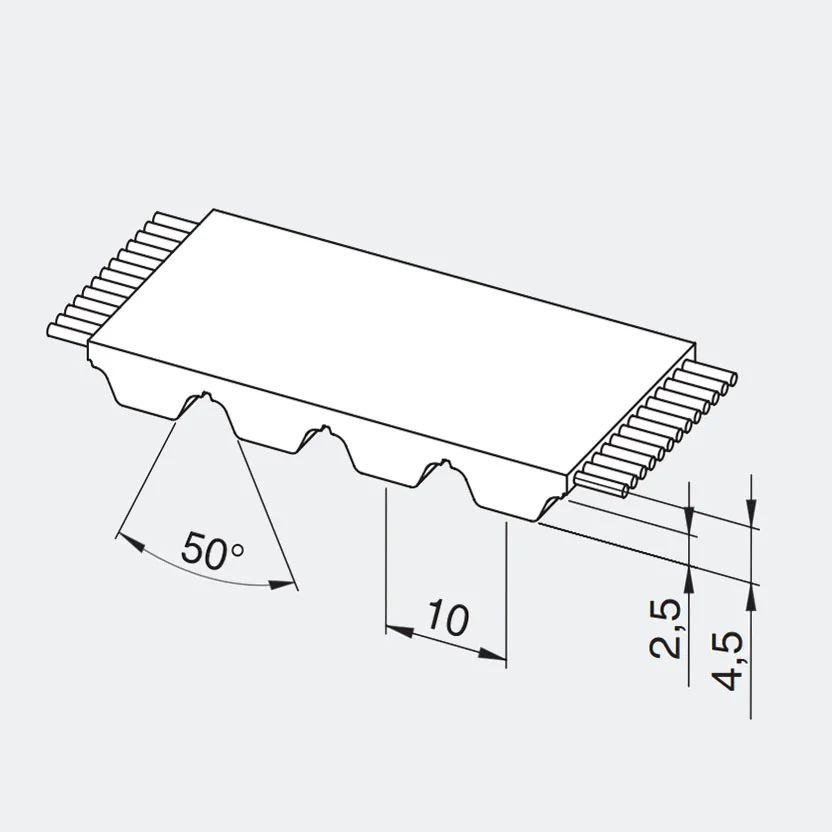




When a timing belt needs to be replaced correctly, the profile, pitch length and number of teeth are the first data that must be correct. The Conti Synchroflex AT10 GEN III 1150 has the AT10 GEN III profile, 10 mm tooth pitch, 1150 mm pitch length and 115 teeth. This makes the product unique in terms of length and profile, while the belt width is selected separately on the product side. The belt is manufactured as an endless Conti Synchroflex PU timing belt with steel cord. The GEN III version is the reinforced high-performance construction with red high-performance polyurethane and a denser, two-filament steel cord. It should therefore be treated as a separate product series and not as the regular standard version.
These specifications can be used as a check against the marking on the old belt or against the machine's spare parts list. The pitch length is not necessarily the same as a measurement across the outside of the belt, and the number of teeth is therefore often the safest additional check. If in doubt, both the belt and timing belt pulleys should be examined before ordering a replacement.
The metric AT geometry has trapezoidal teeth with a larger tooth volume than the standard T profile. The purpose is to distribute the load advantageously in the tooth mesh and achieve higher tooth strength without making the drive unnecessarily large. The profile requires suitable AT timing belt pulleys with the same pitch; a visual similarity to other profiles is not evidence of compatibility.
Conti Synchroflex is manufactured by casting, where the polyurethane is precisely shaped to the tool's tooth geometry around the embedded steel cord tension elements. The casting process provides high pitch accuracy over the entire circumference of the belt and a strong connection between PU and cord. The finished timing belt is endless and therefore has no welded joints. The polyurethane provides a wear-resistant tooth and back surface, while the steel cord takes the longitudinal tensile load.
GEN III is the reinforced high-performance version of the Conti Synchroflex series. The construction uses red high-performance polyurethane, more densely packed steel cord tension elements and a two-filament construction with balanced S and Z cords. Continental states up to 25% higher power transmission than the corresponding AT or ATP standard series. GEN III can use the standard profile timing belt pulleys, but the belt still needs to be dimensioned for the specific drive.
Continental cites construction machinery, pu , paper machines, compressors, compactors, textile machines and roller conveyor drives as examples for this profile family. The examples describe the profile's general area of application, but do not constitute an approval for any specific installation. The final belt width and pretension must be selected based on the transmitted torque, starting and shock loads, operating time, pulley sizes, speed and the number of teeth in simultaneous engagement. For safety-critical or heavily loaded drives, an actual calculation should be made.
The tooth profile of the timing belt pulleys must correspond to the AT10 GEN III of the belt, and their pitch must be 10 mm. The transmission ratio is determined by the ratio of the number of teeth of the pulleys, not by the width of the belt. A larger pulley usually reduces the bending load, while a very small pulley gives more bending per revolution. The angle of engagement and the number of teeth in mesh must be sufficient for the current load.
Proper installation begins with clean, undamaged pulleys with the correct profile. Teeth and grooves should be checked for deposits, bars and wear before the new belt is fitted. The pretension should be based on the drive's calculation and should not be selected based on a random hand feel. After the initial run-in, it is a good idea to check grooveing, noise, temperature and whether the belt runs centrally.
This product line has been created with 16 mm as the base width because this is the width of the selected item and thus the SKU used for inventory control. Integer widths from 16 to 50 mm can be selected on this product page. The widths that appear as standard widths in the supplier data are marked separately in the options. The price surcharge is calculated as a percentage of the base width: doubling the width results in a surcharge of 100%. The technically necessary width should be selected according to the load and not only according to the price.
Uniform light polishing of the tooth flanks may be normal, but localised spalling, ctiming baring or severe wear should be investigated. Wear on one edge often indicates misalignment or persistent flange contact. Damage to tooth tips may be due to incorrect profile, foreign bodies or inadequate engagement. If cord becomes visible or the belt has a sharp break, it should not continue in service without assessment.
Continental specifies a temperature range of up to +100 °C for the GEN III series. When operating close to the temperature limits, the drive must still be dimensioned according to the specific load and environmental conditions. The service life is not only affected by the material, but also by load peaks, bending, pulley size, alignment and surroundings. Keep the drive clean and do not remove deposits with sharp tools that could damage the teeth. If the belt is operating in chemically exposed areas, food environments, clean rooms or at extreme temperatures, a suitable special design should be considered.
When replacing a spare part, the marking on the existing belt should be compared with the product name. Check the profile designation, pitch length, number of teeth, design and width. If the text on the belt has worn away, the number of teeth can be counted and the pitch can be assessed by measuring over several teeth. A single external length measurement is less reliable because the nominal length of the timing belt is indicated in the pitch line.
The Conti Synchroflex series is designed for precise and fast synchronous drives, but the permissible speed depends on the profile, pulley diameter, belt width, load and peripheral speed. A high speed must therefore not be approved based on the product name alone; the drive must be calculated.
No. A timing belt requires timing belt pulleys with the correct profile and pitch, while a V-belt works by friction in V-grooves. A conversion therefore requires new pulleys and a dimensioning of the entire transmission. The product is intended as a timing belt, not as a universal replacement.
No. The timing belt is designed for lubrication-free operation. Oil or grease should not be added to reduce noise as this may mask an alignment, pretension or worn pulley problem. Instead, keep the tooth mesh clean and check the cause of any abnormal noise.
Pulleys should be evaluated if the tooth grooves are worn, sharp, crooked or damaged. A new belt on worn pulleys may have poor load distribution and short life. Also check flanges for bars and side contact and the grooves for foreign objects.
The pitch length is the nominal length measured in the belt cord line where the steel cord tension elements are located. It is not the same as a random outer circumference measurement. For this belt, 1150 mm pitch length corresponds to 115 teeth with 10 mm tooth pitch.
The possibility depends on the profile, cord design, the diameter of the rollers and the specific belt routing. Counter-bending increases the bending load and must be included in the dimensioning. A roller on the belt back must have sufficient diameter and be positioned so that tooth engagement and grooveing are not impaired.
Misalignment can cause the belt to wander towards a flange, causing edge pressure, heat and wear damage. It can also affect tooth engagement and reduce service life. Check both the parallelism of the shafts and the alignment of the pulleys.
Conti Synchroflex AT10 GEN III 1150 is the correct size when the drive requires AT10 GEN III, 1150 mm pitch length and 115 teeth. The belt is cast endless in PU with steel cord and must be used with timing belt pulleys that match the profile. Choose the width according to the technical load and always check the design, alignment and pretension before commissioning.


