Sold out
DISCOUNTED


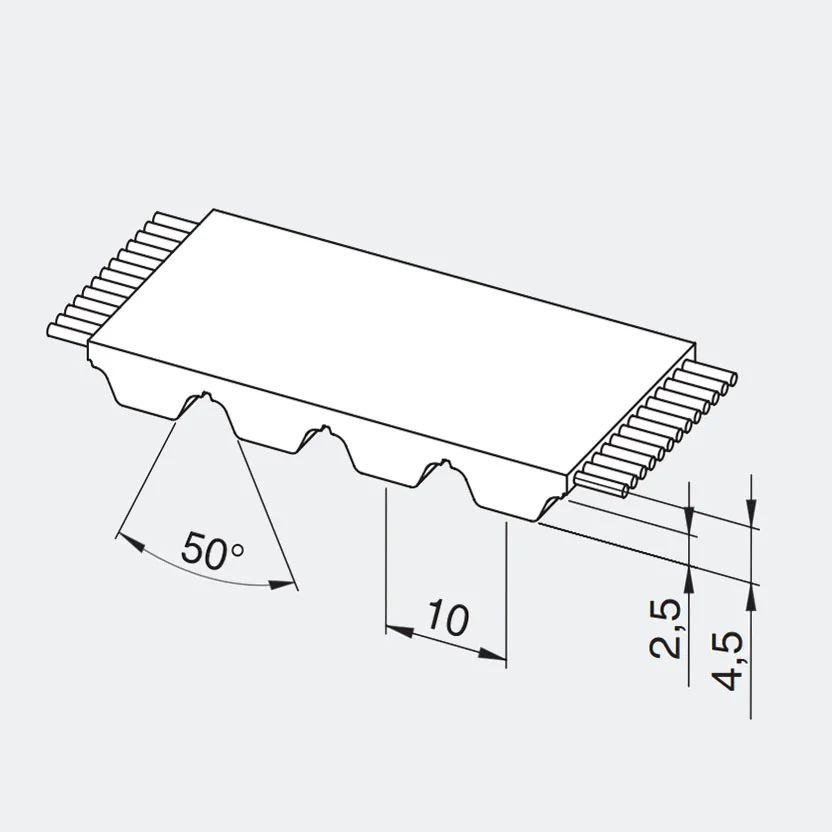




This AT10 GEN III timing belt is specified with a pitch length of 1860 mm and 186 teeth. The ratio between length and number of teeth is fixed: 1860 mm divided by 10 mm gives exactly 186 teeth. The Conti Synchroflex AT10 GEN III 1860 is supplied as a cast, endless PU belt, so that there is no weld joint in the finished ring. The design is developed for synchronous operation and precise machine movements. The GEN III version is the reinforced high-performance design with red high-performance polyurethane and a denser, two-filament steel cord. It should therefore be treated as a separate product series and not as the regular standard version.
The list gathers the information normally used to identify a timing belt: nominal length, number of teeth, profile, material and make. It is important to read all the information together. Two belts can have the same pitch length but be incompatible if the tooth profile or tooth pitch is different. Conversely, a different width does not change the number of teeth as long as the profile and pitch length are the same.
The AT profile has been further developed from the classic T profile. The larger tooth volume provides a higher tooth shear strength, and the profile is designed for a favorable tooth engagement with reduced engagement shocks. This makes the AT series suitable when a drive must be compact and at the same time transmit motion precisely. Continental states that the AT profile can perform up to 50% more than a corresponding T profile, but the actual capacity always depends on width, discs, speed and load profile.
With the cast manufacturing method, the finished belt becomes an exact copy of a precision-machined shape. This is a major reason for the uniform tooth pitch and reproducible length. The steel cord is integrated into the polyurethane and contributes to position and angular precision. The design is suitable for synchronous drives, where a conventional elastic friction belt does not provide the desired repeatability.
GEN III is the reinforced high-performance version of the Conti Synchroflex series. The construction uses red high-performance polyurethane, more densely packed steel cord tension elements and a two-filament construction with balanced S and Z cords. Continental states up to 25% higher power transmission than the corresponding AT or ATP standard series. GEN III can use the standard profile timing belt pulleys, but the belt still needs to be dimensioned for the specific drive.
The profile series is used in practice for tasks such as construction machinery, pu , paper machines, compressors, compactors, textile machines and roller conveyor drives. Common to these machines is the need for a fixed transmission ratio and controlled tooth engagement. A timing belt can transmit both force and position, but the capacity cannot be assessed based on length alone. Width, profile version, wrap angle and load cycle are among the data that must be included in the selection.
The pulleys and belt should be considered as a single tooth engagement. Proper AT10 GEN III geometry ensures that the load is distributed across the tooth flanks rather than concentrated on tooth tips or edges. The drive ratio is selected by the number of teeth on the pulleys, while the belt's 186 teeth and 1860 mm pitch length determine the required combination of pulleys and center distance. When changing the drive, the geometry should be calculated.
The belt must be able to be placed on the pulleys without force. If it can only be mounted by forcing it over a flange, the center distance or mounting procedure is incorrect. The pulley shafts must be aligned and the flanges must be smooth and undamaged. In the case of multi-shaft or counter-bent drives, the diameter and position of the rollers must be assessed separately. Correct pretensioning reduces the risk of tooth skipping without unnecessarily loading the bearings.
This product line has been created with 16 mm as the base width because this is the width of the selected item and thus the SKU used for inventory control. Integer widths from 16 to 50 mm can be selected on this product page. The widths that appear as standard widths in the supplier data are marked separately in the options. The price surcharge is calculated as a percentage of the base width: doubling the width results in a surcharge of 100%. The technically necessary width should be selected according to the load and not only according to the price.
Uniform light polishing of the tooth flanks may be normal, but localised spalling, ctiming baring or severe wear should be investigated. Wear on one edge often indicates misalignment or persistent flange contact. Damage to tooth tips may be due to incorrect profile, foreign bodies or inadequate engagement. If cord becomes visible or the belt has a sharp break, it should not continue in service without assessment.
Continental specifies a temperature range of up to +100 °C for the GEN III series. When operating close to the temperature limits, the drive must still be dimensioned according to the specific load and environmental conditions. The service life is not only affected by the material, but also by load peaks, bending, pulley size, alignment and surroundings. Keep the drive clean and do not remove deposits with sharp tools that could damage the teeth. If the belt is operating in chemically exposed areas, food environments, clean rooms or at extreme temperatures, a suitable special design should be considered.
When replacing a spare part, the marking on the existing belt should be compared with the product name. Check the profile designation, pitch length, number of teeth, design and width. If the text on the belt has worn away, the number of teeth can be counted and the pitch can be assessed by measuring over several teeth. A single external length measurement is less reliable because the nominal length of the timing belt is indicated in the pitch line.
Store the belt in a dry, clean place away from direct sunlight, ozone, strong heat or chemical fumes. It should be free from sharp bends and without heavy loads on top. Avoid hanging a small belt over a sharp hook as this can cause local deformation.
The steel cord tension members absorb the longitudinal tensile load and provide high longitudinal stiffness. This helps maintain pitch and position during operation. The cord must not be kinked, exposed or damaged during installation, as local damage can weaken the belt.
Misalignment can cause the belt to wander towards a flange, causing edge pressure, heat and wear damage. It can also affect tooth engagement and reduce service life. Check both the parallelism of the shafts and the alignment of the pulleys.
No. All width choices on this product page have the same pitch length of 1860 mm and the same number of teeth of 186. Only the width of the belt, and thus the price and possible load capacity, changes. The width must still match the pulleys and the technical dimensioning.
Yes, the belt width can usually be measured directly on the flat back or between clean, undamaged edges. However, the width is only one part of the identification. The profile, pitch length, number of teeth and any DL or GEN III version must also be correct.
The belt has 186 teeth. The number of teeth is calculated by dividing the pitch length of 1860 mm by the tooth pitch of 10 mm. The result is 186, and this number can be used as an additional check when identifying an existing belt. A different number of teeth means a different pitch length.
Noise can be caused by incorrect pretension, skewed pulleys, poor tooth profile compatibility, excessive speed, resonance or worn tooth grooves. Lubrication is not the solution. First check alignment, tension, pulley condition and whether the belt runs without abnormal side contact.
In summary, this is a Conti Synchroflex PU timing belt with a fixed geometry of 10 mm pitch, 186 teeth and 1860 mm pitch length. The width is selected separately, but does not change the length or number of teeth. A safe replacement requires that the entire designation and the specific version match the machine documentation.