New
DISCOUNTED

.webp "Conti Syncroflex GEN III AT20 pu tandrem pu timing belt at20 TPU belt (2).jpg")

_175x175.webp "Syncroflex GEN III AT20 timing belt")


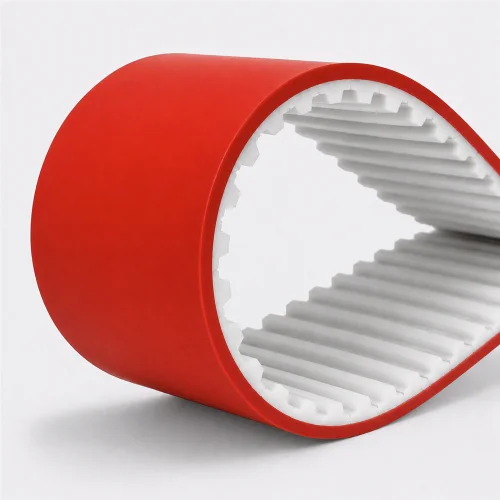
When a timing belt needs to be replaced correctly, the profile, pitch length and number of teeth are the first data that must be correct. The Conti Synchroflex AT20 GEN III 1900 has the AT20 GEN III profile, 20 mm tooth pitch, 1900 mm pitch length and 95 teeth. This makes the product unique in terms of length and profile, while the belt width is selected separately on the product side. The belt is manufactured as an endless Conti Synchroflex PU timing belt with steel cord. The GEN III version is the reinforced high-performance construction with red high-performance polyurethane and a denser, two-filament steel cord. It should therefore be treated as a separate product series and not as the regular standard version.
These specifications can be used as a check against the marking on the old belt or against the machine's spare parts list. The pitch length is not necessarily the same as a measurement across the outside of the belt, and the number of teeth is therefore often the safest additional check. If in doubt, both the belt and timing belt pulleys should be examined before ordering a replacement.
The metric AT geometry has trapezoidal teeth with a larger tooth volume than the standard T profile. The purpose is to distribute the load advantageously in the tooth mesh and achieve higher tooth strength without making the drive unnecessarily large. The profile requires suitable AT timing belt pulleys with the same pitch; a visual similarity to other profiles is not evidence of compatibility.
The endless PU construction combines low dead weight with high longitudinal rigidity. The steel cord tension elements are cast into the belt and are not intended to be exposed, damaged or sharply broken during installation. The wear resistance of the polyurethane and the strong bond to the cord are central to the belt's lifespan. Correct handling is therefore just as important as the correct choice of profile and length.
The red GEN III construction is not just a color variant. It is developed with higher cord density and a special steel cord construction that provides increased tensile strength, better grooveing and the ability to carry higher loads. The catalog also specifies a temperature range up to +100 °C. Standard and GEN III must therefore be created and selected as separate products, even when the length and profile are the same.
The application examples in the catalogue include heavy-duty drives, textile machines, printing machines, machine tools and larger industrial power transmissions. This shows that the profile can be used in both power transmission and motion control. However, the specific belt must only be finally selected when the machine's torque, speed, center distance and pulley geometry are known. When simply replacing a spare part, the safest method is usually to copy the documented profile, length, design and width.
Continental specifies a temperature range of up to +100 °C for the GEN III series. When operating close to the temperature limits, the drive must still be dimensioned according to the specific load and environmental conditions. The service life is not only affected by the material, but also by load peaks, bending, pulley size, alignment and surroundings. Keep the drive clean and do not remove deposits with sharp tools that could damage the teeth. If the belt is operating in chemically exposed areas, food environments, clean rooms or at extreme temperatures, a suitable special design should be considered.
The belt width is not written in the product name because the same pitch length is collected on one product page. The starting pu is 16 mm. Integer widths from 16 to 50 mm can be selected on this product page. The original supplier widths for this length are 16, 20, 25, 32 and 50 mm. Other intermediate sizes are offered as cut-to-sizes of the same type of timing belt sleeve when they are within the selection shown. The number of teeth, pitch length and profile do not change when the width is changed.
The tooth profile of the timing belt pulleys must correspond to the AT20 GEN III of the belt, and their pitch must be 20 mm. The transmission ratio is determined by the ratio of the number of teeth of the pulleys, not by the width of the belt. A larger pulley usually reduces the bending load, while a very small pulley gives more bending per revolution. The angle of engagement and the number of teeth in mesh must be sufficient for the current load.
The timing belt pulleys must be parallel and in the same plane. Even minor misalignments can cause the belt to move towards a flange and cause edge or cord damage. The belt should be installed without being twisted, sharply bent or pressed over a flange with a tool. The center distance is adjusted to achieve the calculated preload. Too high a tension increases the bearing and cord load, while too low a tension can cause tooth jumps at load peaks.
A properly running timing belt should move smoothly without continuous contact against one flange. Regularly check the teeth for deformation, the back for ctiming bars and the edges for frayed areas. Abnormal noise or heat can be an early sign of incorrect tension or pulley failure. A systematic check of pulleys and belt is more effective than trying to hide symptoms with lubricant.
The 95 teeth of the product provide a convenient length check. Multiplying the number of teeth by 20 mm gives a pitch length of 1900 mm. If an existing belt has a different number of teeth, it is not the same size, even though it may look almost the same length. Also check that the teeth of the pulleys match the AT20 GEN III; the same pitch number alone is not always sufficient.
No. The Conti Synchroflex series is manufactured as cast, endless timing belts. The belt therefore does not have a welded joint around the circumference. The cast process provides a uniform tooth pitch around the entire belt and a strong bond between the polyurethane and the cast steel cord tension elements.
Yes, the belt width can usually be measured directly on the flat back or between clean, undamaged edges. However, the width is only one part of the identification. The profile, pitch length, number of teeth and any DL or GEN III version must also be correct.
The standard version is single-sided with teeth on the inside and a smooth back. It must run with the teeth in the corresponding tooth grooves; the back is not an alternative tooth side.
The number of teeth links the pitch of the profile to the nominal length of the belt. For this size, 95 teeth at 20 mm pitch gives a length of 1900 mm. It is a simple check that often reveals faults that are not visible by a quick comparison of two loose belts.
Continental states that the GEN III version can be used on standard timing belt pulleys for the corresponding AT20 profile. However, the pulleys must be in good condition and the drive must be dimensioned for the load you want to utilize.
The tooth pitch is the distance from one tooth to the next and is 20 mm for this profile. The pitch length is the entire nominal circumference in the cord line and is 1900 mm. When the pitch length is divided by the tooth pitch, the belt has 95 teeth.
Pulleys should be evaluated if the tooth grooves are worn, sharp, crooked or damaged. A new belt on worn pulleys may have poor load distribution and short life. Also check flanges for bars and side contact and the grooves for foreign objects.
Conti Synchroflex AT20 GEN III 1900 is the correct size when the drive requires AT20 GEN III, 1900 mm pitch length and 95 teeth. The belt is cast endless in PU with steel cord and must be used with timing belt pulleys that match the profile. Choose the width according to the technical load and always check the design, alignment and pretension before commissioning.


_500x500.webp)