
New


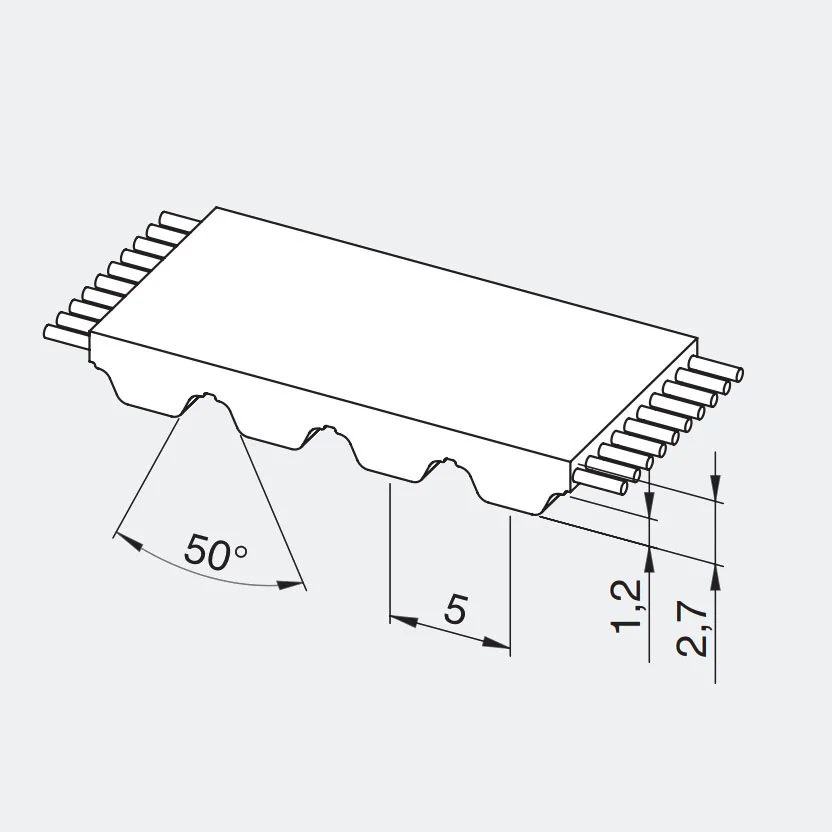




The Conti Synchroflex AT5 GEN III 3800 combines a precise AT5 GEN III tooth geometry with a molded polyurethane body and longitudinally stable steel cord tension elements. The product has 760 teeth and a pitch length of 3800 mm, which corresponds to a tooth pitch of 5 mm. The belt is used in synchronous drives where uniform movement and reproducible position are more important than the elasticity normally associated with a conventional V-belt or flat belt. The GEN III version is the reinforced high-performance construction with red high-performance polyurethane and a denser, two-filament steel cord. It should therefore be treated as a separate product series and not as the usual standard version.
These specifications can be used as a check against the marking on the old belt or against the machine's spare parts list. The pitch length is not necessarily the same as a measurement across the outside of the belt, and the number of teeth is therefore often the safest additional check. If in doubt, both the belt and timing belt pulleys should be examined before ordering a replacement.
The metric AT geometry has trapezoidal teeth with a larger tooth volume than the standard T profile. The purpose is to distribute the load advantageously in the tooth mesh and achieve higher tooth strength without making the drive unnecessarily large. The profile requires suitable AT timing belt pulleys with the same pitch; a visual similarity to other profiles is not evidence of compatibility.
The belt body consists of wear-resistant polyurethane, which encloses high-strength steel cord. The materials each have their own function: PU forms the teeth and protects the belt against mechanical wear, while the cord tensioning elements provide high longitudinal stiffness and limit post-elongation. Continental describes the design as maintenance-friendly and lubrication-free. This does not mean that the drive can be ignored; pulleys, alignment and pretension should still be checked.
In the GEN III series, both the polyurethane and the tension body are optimized for higher performance. The tighter cord packing can increase the permissible tensile load, and the balanced two-filament construction is designed to reduce flange friction and improve belt running. Continental states that existing standard AT or ATP pulleys can be used with the corresponding GEN III profile. However, the remaining dimensioning of the drive still needs to be checked.
The profile series is used in practice for tasks such as machine tools, pu , textile machines and positioning and conveying systems. Common to these machines is the need for a fixed transmission ratio and controlled tooth engagement. A timing belt can transmit both force and position, but the capacity cannot be assessed based on length alone. Width, profile version, wrap angle and load cycle are among the data that must be included in the selection.
Continental specifies a temperature range of up to +100 °C for the GEN III series. When operating close to the temperature limits, the drive must still be dimensioned according to the specific load and environmental conditions. The timing belt operates without lubrication, and oil or grease should therefore not be added to dampen noise. The polyurethane is described as resistant to aging as well as simple oils, grease and petrol and to certain acids and bases. In the case of permanent contact, cleaning chemicals or unknown media, material compatibility should be specifically clarified.
The belt width is not written in the product name because the same pitch length is collected on one product page. The starting pu is 32 mm. Integer widths from 32 to 50 mm can be selected on this product page. The original supplier widths for this length are 32 mm. Other intermediate sizes are offered as cut-to-size versions of the same type of timing belt sleeve when they are within the selection shown. The number of teeth, pitch length and profile do not change when the width is changed.
The tooth profile of the timing belt pulleys must correspond to the AT5 GEN III of the belt, and their pitch must be 5 mm. The transmission ratio is determined by the ratio of the number of teeth of the pulleys, not by the width of the belt. A larger pulley usually reduces the bending load, while a very small pulley gives more bending per revolution. The angle of engagement and the number of teeth in mesh must be sufficient for the current load.
The belt must be able to be placed on the pulleys without force. If it can only be mounted by forcing it over a flange, the center distance or mounting procedure is incorrect. The pulley shafts must be aligned and the flanges must be smooth and undamaged. In the case of multi-shaft or counter-bent drives, the diameter and position of the rollers must be assessed separately. Correct pretensioning reduces the risk of tooth skipping without unnecessarily loading the bearings.
A properly running timing belt should move smoothly without continuous contact against one flange. Regularly check the teeth for deformation, the back for ctiming bars and the edges for frayed areas. Abnormal noise or heat can be an early sign of incorrect tension or pulley failure. A systematic check of pulleys and belt is more effective than trying to hide symptoms with lubricant.
When replacing a spare part, the marking on the existing belt should be compared with the product name. Check the profile designation, pitch length, number of teeth, design and width. If the text on the belt has worn away, the number of teeth can be counted and the pitch can be assessed by measuring over several teeth. A single external length measurement is less reliable because the nominal length of the timing belt is indicated in the pitch line.
This product is already GEN III. The reinforced version features high-performance PU and denser, two-filament steel cord construction and is a separate product line from the standard belt.
Check that the belt runs centrally, that there is no abnormal heat or noise, and that the edges are not constantly rubbing against the flanges. Also look for signs of too low or too high pretension. If the drive requires a re-tension check, the machine manufacturer's procedure must be followed.
No. All width choices on this product page have the same pitch length of 3800 mm and the same number of teeth of 760. Only the width of the belt, and thus the price and possible load capacity, changes. The width must still match the pulleys and the technical dimensioning.
No, not without documented compatibility. The 5 mm tooth pitch describes the distance between the teeth, but the shape and clearance of the tooth flanks may differ. The belt must be used with pulleys manufactured for AT5 profile. Visual similarity is not sufficient documentation.
Yes, the belt width can usually be measured directly on the flat back or between clean, undamaged edges. However, the width is only one part of the identification. The profile, pitch length, number of teeth and any DL or GEN III version must also be correct.
Count the teeth and check the pitch. 760 teeth times 5 mm gives 3800 mm pitch length. Then compare the profile and design with the marking or the machine spare parts list. A measurement around the outside of the belt alone is not accurate enough.
The possibility depends on the profile, cord design, the diameter of the rollers and the specific belt routing. Counter-bending increases the bending load and must be included in the dimensioning. A roller on the belt back must have sufficient diameter and be positioned so that tooth engagement and grooveing are not impaired.
Continental states that the GEN III version can be used on standard timing belt pulleys for the corresponding AT5 profile. However, the pulleys must be in good condition and the drive must be dimensioned for the load you want to utilize.
In summary, this is a Conti Synchroflex PU timing belt with a fixed geometry of 5 mm pitch, 760 teeth and 3800 mm pitch length. The width is selected separately, but does not change the length or number of teeth. A safe replacement requires that the entire designation and the specific version match the machine documentation.


