
New
DISCOUNTED


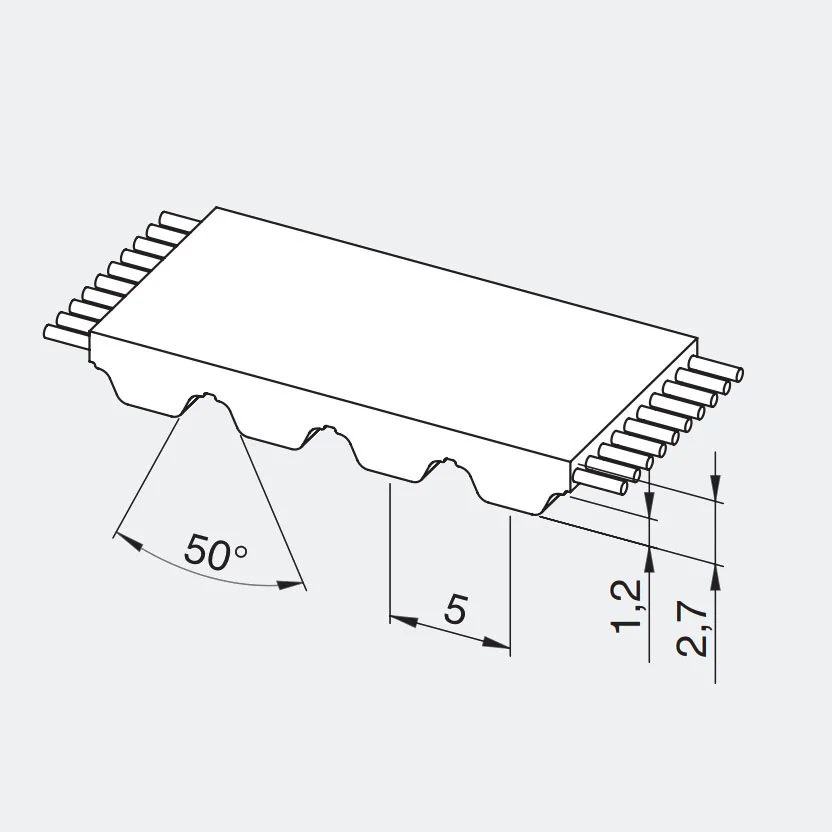




When a timing belt needs to be replaced correctly, the profile, pitch length and number of teeth are the first data that must be correct. The Conti Synchroflex AT5 GEN III 780 has the AT5 GEN III profile, 5 mm tooth pitch, 780 mm pitch length and 156 teeth. This makes the product unique in terms of length and profile, while the belt width is selected separately on the product side. The belt is manufactured as an endless Conti Synchroflex PU timing belt with steel cord. The GEN III version is the reinforced high-performance construction with red high-performance polyurethane and a denser, two-filament steel cord. It should therefore be treated as a separate product series and not as the regular standard version.
The list gathers the information normally used to identify a timing belt: nominal length, number of teeth, profile, material and make. It is important to read all the information together. Two belts can have the same pitch length but be incompatible if the tooth profile or tooth pitch is different. Conversely, a different width does not change the number of teeth as long as the profile and pitch length are the same.
In a synchronous belt drive, the movement is transmitted through the tooth flanks. The geometry of the AT profile is therefore crucial for both load distribution, noise level and position accuracy. A correct AT pulley supports the teeth according to the profile to which they are cast. If the pulley's tooth shape or pitch deviates, the load can be concentrated at a few pu and cause abnormal wear, even though the belt can apparently be mounted.
Conti Synchroflex is manufactured by casting, where the polyurethane is precisely shaped to the tool's tooth geometry around the embedded steel cord tension elements. The casting process provides high pitch accuracy over the entire circumference of the belt and a strong connection between PU and cord. The finished timing belt is endless and therefore has no welded joints. The polyurethane provides a wear-resistant tooth and back surface, while the steel cord takes the longitudinal tensile load.
GEN III is the reinforced high-performance version of the Conti Synchroflex series. The construction uses red high-performance polyurethane, more densely packed steel cord tension elements and a two-filament construction with balanced S and Z cords. Continental states up to 25% higher power transmission than the corresponding AT or ATP standard series. GEN III can use the standard profile timing belt pulleys, but the belt still needs to be dimensioned for the specific drive.
Continental cites machine tools, pu , textile machines and positioning and conveying systems as examples for this profile family. The examples describe the general area of application of the profile, but do not constitute an approval for any specific installation. The final belt width and pretension must be selected based on the transmitted torque, starting and shock loads, operating time, pulley sizes, speed and the number of teeth in simultaneous engagement. For safety-critical or heavily loaded drives, an actual calculation should be made.
The basic price applies to 6 mm, and the other widths are calculated with the same percentage logic as the existing PU timing belts in the webshop. Integer widths from 6 to 50 mm can be selected on this product page. A width of twice the basic width therefore costs 100% more, while a width of one and a half times the basic width gives approximately 50% extra. This price rule is a webshop calculation; it does not replace a technical dimensioning of the belt's load-bearing capacity.
A belt with the correct length can still function poorly if the pulleys have the wrong profile, are worn or are misaligned. Therefore, check the tooth grooves, flanges, shaft alignment and the number of teeth on the pulleys. For AT5 GEN III, the nominal tooth pitch is 5 mm. The fixed tooth mesh makes the gear ratio reproducible, but only when the belt has sufficient wrap and does not run with constant side pressure.
Proper installation begins with clean, undamaged pulleys with the correct profile. Teeth and grooves should be checked for deposits, bars and wear before the new belt is fitted. The pretension should be based on the drive's calculation and should not be selected based on a random hand feel. After the initial run-in, it is a good idea to check grooveing, noise, temperature and whether the belt runs centrally.
The product's 156 teeth provide a convenient length check. Multiplying the number of teeth by 5 mm gives a pitch length of 780 mm. If an existing belt has a different number of teeth, it is not the same size, even though it may look almost the same length. Also check that the teeth on the pulleys match AT5 GEN III; the same pitch number alone is not always sufficient.
A properly running timing belt should move smoothly without continuous contact against one flange. Regularly check the teeth for deformation, the back for ctiming bars and the edges for frayed areas. Abnormal noise or heat can be an early sign of incorrect tension or pulley failure. A systematic check of pulleys and belt is more effective than trying to hide symptoms with lubricant.
Continental specifies a temperature range of up to +100 °C for the GEN III series. When operating close to the temperature limits, the drive must still be dimensioned according to the specific load and environmental conditions. The service life is not only affected by the material, but also by load peaks, bending, pulley size, alignment and surroundings. Keep the drive clean and do not remove deposits with sharp tools that could damage the teeth. If the belt is operating in chemically exposed areas, food environments, clean rooms or at extreme temperatures, a suitable special design should be considered.
No. A timing belt requires timing belt pulleys with the correct profile and pitch, while a V-belt works by friction in V-grooves. A conversion therefore requires new pulleys and a dimensioning of the entire transmission. The product is intended as a timing belt, not as a universal replacement.
Pulleys should be evaluated if the tooth grooves are worn, sharp, crooked or damaged. A new belt on worn pulleys may have poor load distribution and short life. Also check flanges for bars and side contact and the grooves for foreign objects.
The standard PU is described as resistant to simple oils, grease and petrol as well as certain acids and bases. This does not mean universal chemical resistance. In the case of continuous contact, high concentrations or cleaning agents, the specific liquid, temperature and exposure time should be assessed.
The belt has 156 teeth. The number of teeth is calculated by dividing the pitch length of 780 mm by the tooth pitch of 5 mm. The result is 156, and this number can be used as an additional check when identifying an existing belt. A different number of teeth means a different pitch length.
This should be avoided. The belt should be installed by adjusting the center distance or following the correct installation procedure for the machine. Forcing it over a flange can damage the cord pullers, teeth or belt edge. After installation, the pulleys must be parallel and the pretension must be correct.
Check that the belt runs centrally, that there is no abnormal heat or noise, and that the edges are not constantly rubbing against the flanges. Also look for signs of too low or too high pretension. If the drive requires a re-tension check, the machine manufacturer's procedure must be followed.
The standard version is single-sided with teeth on the inside and a smooth back. It must run with the teeth in the corresponding tooth grooves; the back is not an alternative tooth side.
Conti Synchroflex AT5 GEN III 780 is the correct size when the drive requires AT5 GEN III, 780 mm pitch length and 156 teeth. The belt is cast endless in PU with steel cord and must be used with timing belt pulleys that match the profile. Choose the width according to the technical load and always check the design, alignment and pretension before commissioning.


