Sold out
DISCOUNTED
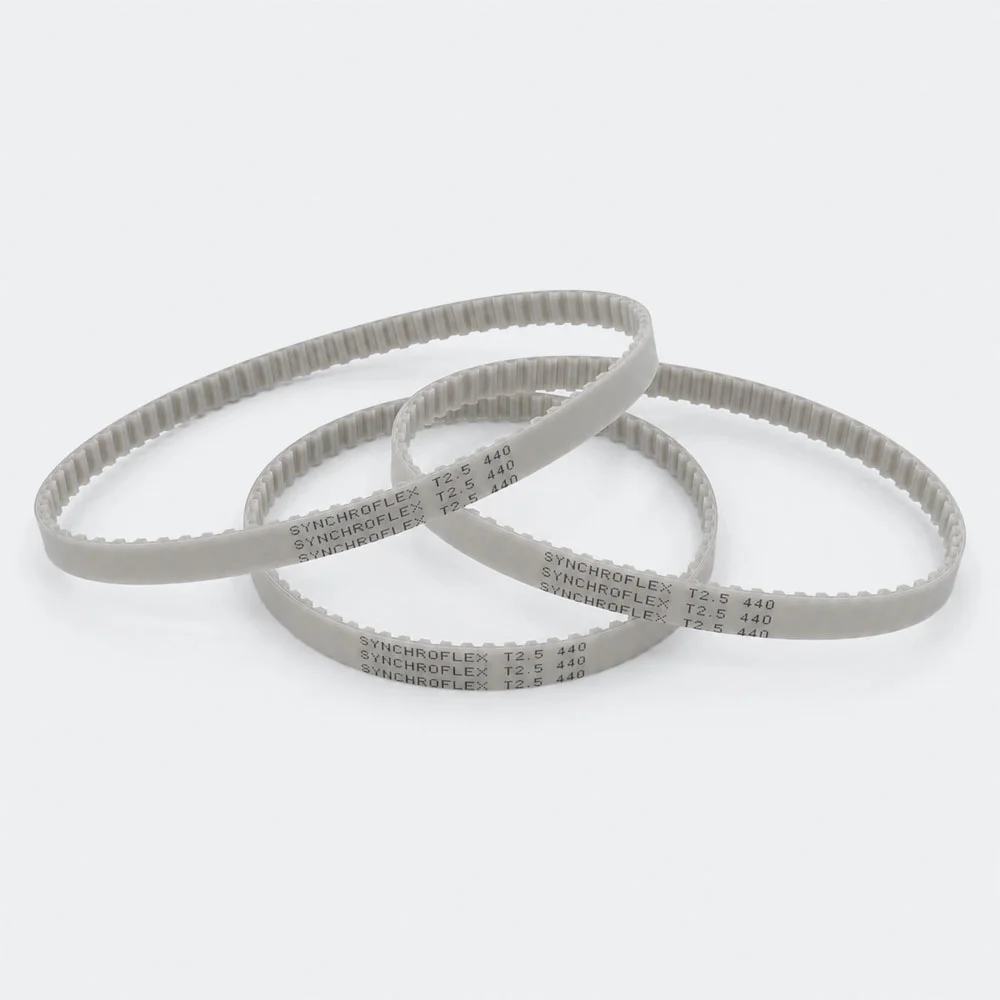


With 73 teeth spread over a pitch length of 182.5 mm, the Conti Synchroflex T2.5 182.5 is designed for precise transmission of rotation, timing and position. The belt is cast endlessly in PU and has integrated steel cord tension elements that stabilize the length during normal operation. The nominal tooth pitch is 2.5 mm and the tooth profile must match the profile of the pulleys exactly. It is not sufficient for another belt to have approximately the same length or width. This is the standard version in the specified profile. It must not be confused with a possible GEN III version or a double-sided DL belt with the same pitch length.
The technical data below describes the part of the product that does not change when a different belt width is selected. Pitch length, tooth pitch and number of teeth remain identical for all width choices. However, the width affects the available belt cross-section width and the price calculated on the product page. Correct sizing must always take into account torque, speed, number of teeth in mesh, pulley diameters, service factor and any counter-bending.
The trapezoidal T-geometry is a standardized solution for synchronous transmission. The teeth mesh with corresponding grooves in the timing belt pulley, so that the speed ratio is maintained without slipping. The correct pitch is crucial: a T5 belt, for example, will not fit in an AT5 pulley simply because the tooth pitch is 5 mm in both places. The shape and clearance of the tooth flanks are different.
With the cast manufacturing method, the finished belt becomes an exact copy of a precision-machined shape. This is a major reason for the uniform tooth pitch and reproducible length. The steel cord is integrated into the polyurethane and contributes to position and angular precision. The design is suitable for synchronous drives, where a conventional elastic friction belt does not provide the desired repeatability.
The product is the regular Conti Synchroflex standard version in the specified profile. Standard and GEN III may have the same pitch length and number of teeth, but they are different product series with different material construction and capacity data. The same applies to a DL belt, which has teeth on both sides. When reordering, the entire profile designation should therefore be checked, not just the length.
It is not enough to compare the total circumference of a belt. The correct replacement must have the same pitch, tooth profile and number of teeth as the existing drive. The width must match the pulleys and the required capacity, and a DL or GEN III version must be identified separately. If in doubt, pictures of the marking, tooth profile and pulleys can be used as a supplement, but a documented spare part designation is best.
The profile series is used in practice for tasks such as precision mechanics, positioning drives, small synchronous machine movements and measuring and control equipment. Common to these machines is the need for a fixed transmission ratio and controlled tooth meshing. A timing belt can transmit both force and position, but the capacity cannot be assessed based on length alone. Width, profile version, wrap angle and load cycle are among the data that must be included in the selection.
The belt width is not written in the product name because the same pitch length is collected on one product page. The starting pu is 4 mm. Integer widths from 4 to 50 mm can be selected on this product page. The original supplier widths for this length are 4, 6, 8, 10 and 12 mm. Other intermediate sizes are offered as cut-to-size versions of the same type of timing belt sleeve when they are within the selection shown. The number of teeth, pitch length and profile do not change when the width is changed.
The tooth profile of the timing belt pulleys must correspond to the T2.5 of the belt, and their pitch must be 2.5 mm. The transmission ratio is determined by the ratio of the number of teeth of the pulleys, not by the width of the belt. A larger pulley usually reduces the bending load, while a very small pulley gives more bending per revolution. The angle of engagement and the number of teeth in mesh must be sufficient for the current load.
The timing belt pulleys must be parallel and in the same plane. Even minor misalignments can cause the belt to move towards a flange and cause edge or cord damage. The belt should be installed without being twisted, sharply bent or pressed over a flange with a tool. The center distance is adjusted to achieve the calculated preload. Too high a tension increases the bearing and cord load, while too low a tension can cause tooth jumps at load peaks.
The standard material is specified for ambient temperatures from -30 °C to +80 °C. Applications close to the limits, especially below -10 °C or above +50 °C, may require special dimensioning. The timing belt operates without lubrication, and oil or grease should therefore not be added to dampen noise. The polyurethane is described as resistant to aging as well as simple oils, grease and petrol and to certain acids and bases. In the case of permanent contact, cleaning chemicals or unknown media, material compatibility should be specifically clarified.
A properly running timing belt should move smoothly without continuous contact against one flange. Regularly check the teeth for deformation, the back for ctiming bars and the edges for frayed areas. Abnormal noise or heat can be an early sign of incorrect tension or pulley failure. A systematic check of pulleys and belt is more effective than trying to hide symptoms with lubricant.
The possibility depends on the profile, cord design, the diameter of the rollers and the specific belt routing. Counter-bending increases the bending load and must be included in the dimensioning. A roller on the belt back must have sufficient diameter and be positioned so that tooth engagement and grooveing are not impaired.
No. A timing belt requires timing belt pulleys with the correct profile and pitch, while a V-belt works by friction in V-grooves. A conversion therefore requires new pulleys and a dimensioning of the entire transmission. The product is intended as a timing belt, not as a universal replacement.
No. This is a cast endless timing belt with a fixed pitch length. It can be cut to width within the available options, but the circumference and number of teeth cannot be changed. If the length needs to be changed, a different cast belt size is required.
The number of teeth links the pitch of the profile to the nominal length of the belt. For this size, 73 teeth at 2.5 mm pitch gives a length of 182.5 mm. It is a simple check that often reveals faults that are not visible by a quick comparison of two loose belts.
The standard version is specified for ambient temperatures from -30 °C to +80 °C. At temperatures below -10 °C or above +50 °C, adapted sizing may be required.
The tooth engagement provides a positive, synchronous transmission without the normal slippage of a friction belt. This makes the profile relevant for positioning tasks, but the achievable accuracy also depends on the quality of the pulleys, shaft play, belt pretension, load and the overall machine design.
This should be avoided. The belt should be installed by adjusting the center distance or following the correct installation procedure for the machine. Forcing it over a flange can damage the cord pullers, teeth or belt edge. After installation, the pulleys must be parallel and the pretension must be correct.
In summary, this is a Conti Synchroflex PU timing belt with a fixed geometry of 2.5 mm pitch, 73 teeth and 182.5 mm pitch length. The width is selected separately, but does not change the length or number of teeth. A safe replacement requires that the entire designation and the specific version match the machine documentation.