New
DISCOUNTED
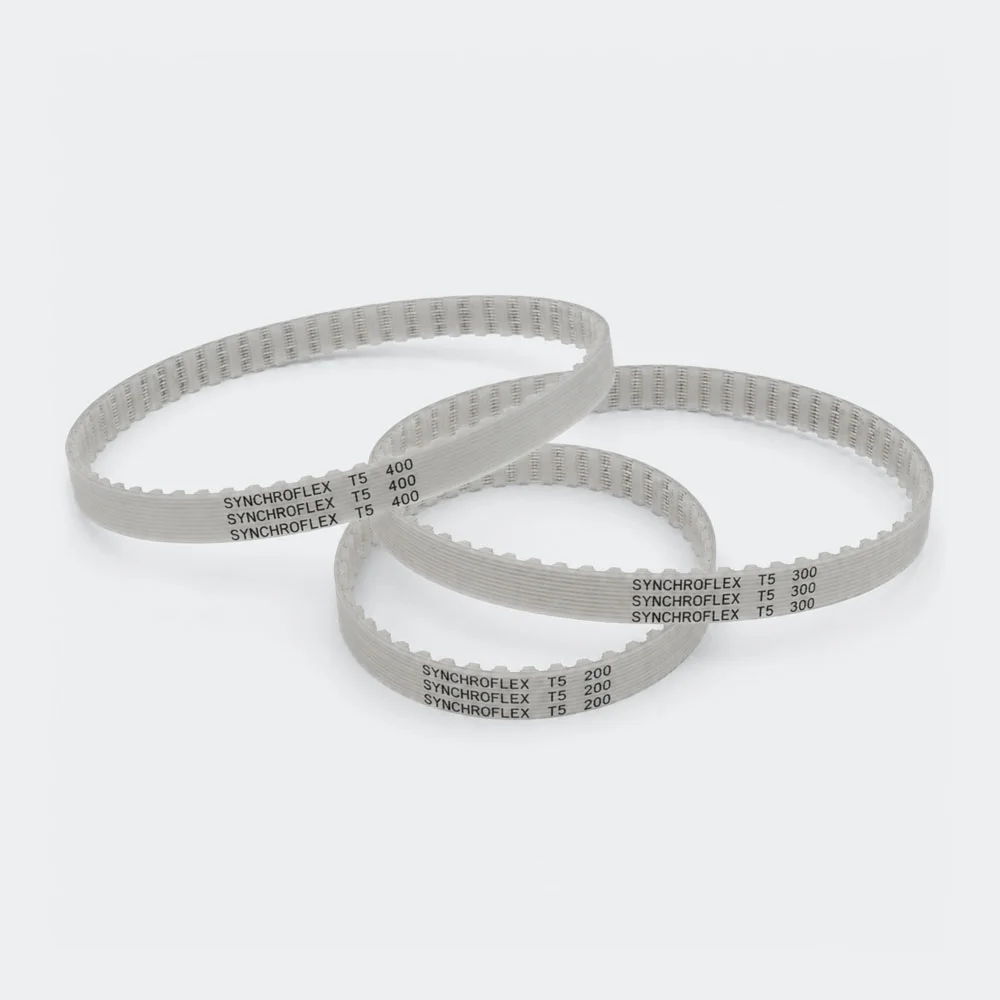


Conti Synchroflex T5 510 is an endless, cast polyurethane timing belt with 102 teeth, 5 mm tooth pitch and a pitch length of 510 mm. It is intended for synchronous power transmission, where the driving and driven shafts must follow a fixed tooth ratio without the slippage known from friction-based belt drives. The pitch length is the nominal length measurement in the cord line of the belt and is therefore the measurement that must be compared with the existing belt, the machine's spare parts data and the installed timing belt pulleys. This is the standard version in the specified profile. It must not be confused with a possible GEN III version or a double-sided DL belt with the same pitch length.
These specifications can be used as a check against the marking on the old belt or against the machine's spare parts list. The pitch length is not necessarily the same as a measurement across the outside of the belt, and the number of teeth is therefore often the safest additional check. If in doubt, both the belt and timing belt pulleys should be examined before ordering a replacement.
As a classic metric profile, the T-series is used in many machines where reliable synchronous movement is important. The tooth shape is trapezoidal, and the number in the profile designation indicates the tooth pitch in millimeters. The correct washer must therefore both have the same pitch and be manufactured for the T-profile. The wrong profile can lead to poor engagement, noise and rapid wear.
Conti Synchroflex is manufactured by casting, where the polyurethane is precisely shaped to the tool's tooth geometry around the embedded steel cord tension elements. The casting process provides high pitch accuracy over the entire circumference of the belt and a strong connection between PU and cord. The finished timing belt is endless and therefore has no welded joints. The polyurethane provides a wear-resistant tooth and back surface, while the steel cord takes the longitudinal tensile load.
The product is the regular Conti Synchroflex standard version in the specified profile. Standard and GEN III may have the same pitch length and number of teeth, but they are different product series with different material construction and capacity data. The same applies to a DL belt, which has teeth on both sides. When reordering, the entire profile designation should therefore be checked, not just the length.
The application examples in the catalogue include office machines, household appliances, positioning drives and control drives. This shows that the profile can be used in both power transmission and motion control. However, the specific belt must only be finally selected when the machine's torque, speed, centre distance and pulley geometry are known. When simply replacing a spare part, the safest method is usually to copy the documented profile, length, design and width.
A belt of the correct length can still function poorly if the pulleys have the wrong profile, are worn or are misaligned. Therefore, check the tooth grooves, flanges, shaft alignment and the number of teeth on the pulleys. For T5, the nominal tooth pitch is 5 mm. The fixed tooth mesh makes the gear ratio reproducible, but only when the belt has sufficient wrap and does not run with constant side pressure.
When installing, the cord pullers must be protected against kinks and local pressure damage. The belt must not be pinched with pliers or a screwdriver, and it should not be folded sharply. Check that the pulleys have the same pitch and profile as the belt and that they are not worn out. A stable drive is achieved through the right combination of alignment, wrapping and calculated pretension.
The belt width is not written in the product name because the same pitch length is collected on one product page. The starting pu is 6 mm. Integer widths from 6 to 50 mm can be selected on this product page. The original supplier widths for this length are 6, 8, 10, 12, 16, 20, 25, 32 and 50 mm. Other intermediate sizes are offered as cut-to-size versions of the same type of timing belt sleeve when they are within the selection shown. The number of teeth, pitch length and profile do not change when the width is changed.
A properly running timing belt should move smoothly without continuous contact against one flange. Regularly check the teeth for deformation, the back for ctiming bars and the edges for frayed areas. Abnormal noise or heat can be an early sign of incorrect tension or pulley failure. A systematic check of pulleys and belt is more effective than trying to hide symptoms with lubricant.
The standard material is specified for ambient temperatures from -30 °C to +80 °C. Applications close to the limits, especially below -10 °C or above +50 °C, may require special sizing. The molded PU belt is maintenance-friendly and does not require lubricant. Regular visual inspection is still relevant: look for ctiming bars, frayed edges, shiny tooth flanks, foreign body impressions and abnormal side contact. Sudden changes in noise or grooveing may indicate misalignment, too low tension or worn pulleys.
The product's 102 teeth provide a convenient length check. Multiplying the number of teeth by 5 mm gives a pitch length of 510 mm. If an existing belt has a different number of teeth, it is not the same size, even though it may look almost the same length. Also check that the teeth on the pulleys match the T5; the same pitch number alone is not always sufficient.
Not necessarily. A larger width provides a more active belt cross-section and can increase the permissible load, but the drive capacity also depends on the profile, number of teeth in mesh, pulley size, speed, load factor and preload. The width should be selected by an overall calculation.
Misalignment can cause the belt to wander towards a flange, causing edge pressure, heat and wear damage. It can also affect tooth engagement and reduce service life. Check both the parallelism of the shafts and the alignment of the pulleys.
This product is the standard version. GEN III is a separate reinforced series with red high-performance PU and denser, two-filament steel cord. The same profile and length therefore do not mean that the products are identical.
Correct pretension keeps the teeth in stable engagement and reduces the risk of tooth jump. Too low a tension can cause impact and jump under load, while too high a tension increases the load on the cord, pulleys and bearings. The correct value must be determined based on the drive's dimensioning.
The possibility depends on the profile, cord design, the diameter of the rollers and the specific belt routing. Counter-bending increases the bending load and must be included in the dimensioning. A roller on the belt back must have sufficient diameter and be positioned so that tooth engagement and grooveing are not impaired.
The tooth engagement provides a positive, synchronous transmission without the normal slippage of a friction belt. This makes the profile relevant for positioning tasks, but the achievable accuracy also depends on the quality of the pulleys, shaft play, belt pretension, load and the overall machine design.
No. A timing belt requires timing belt pulleys with the correct profile and pitch, while a V-belt works by friction in V-grooves. A conversion therefore requires new pulleys and a dimensioning of the entire transmission. The product is intended as a timing belt, not as a universal replacement.
The Conti Synchroflex series is designed for precise and fast synchronous drives, but the permissible speed depends on the profile, pulley diameter, belt width, load and peripheral speed. A high speed must therefore not be approved based on the product name alone; the drive must be calculated.
Conti Synchroflex T5 510 is the correct size when the drive requires T5, 510 mm pitch length and 102 teeth. The belt is cast endless in PU with steel cord and must be used with timing belt pulleys that match the profile. Choose the width according to the technical load and always check the design, alignment and pretension before commissioning.