New
DISCOUNTED


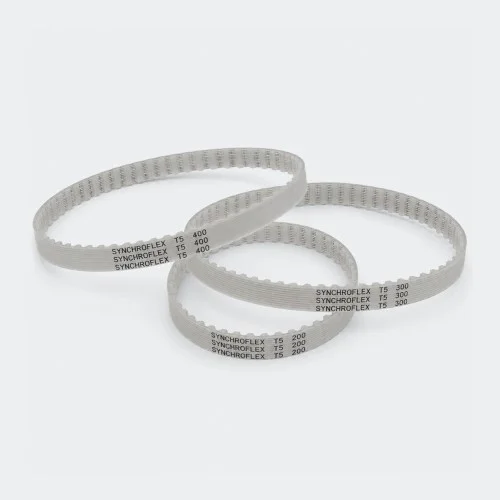
When a timing belt needs to be replaced correctly, the profile, pitch length and number of teeth are the first data that must be correct. The Conti Synchroflex AT3 GEN III 351 has the AT3 GEN III profile, 3 mm tooth pitch, 351 mm pitch length and 117 teeth. This makes the product unique in terms of length and profile, while the belt width is selected separately on the product side. The belt is manufactured as an endless Conti Synchroflex PU timing belt with steel cord. The GEN III version is the reinforced high-performance construction with red high-performance polyurethane and a denser, two-filament steel cord. It should therefore be treated as a separate product series and not as the regular standard version.
These specifications can be used as a check against the marking on the old belt or against the machine's spare parts list. The pitch length is not necessarily the same as a measurement across the outside of the belt, and the number of teeth is therefore often the safest additional check. If in doubt, both the belt and timing belt pulleys should be examined before ordering a replacement.
The metric AT geometry has trapezoidal teeth with a larger tooth volume than the standard T profile. The purpose is to distribute the load advantageously in the tooth mesh and achieve higher tooth strength without making the drive unnecessarily large. The profile requires suitable AT timing belt pulleys with the same pitch; a visual similarity to other profiles is not evidence of compatibility.
The endless PU construction combines low dead weight with high longitudinal rigidity. The steel cord tension elements are cast into the belt and are not intended to be exposed, damaged or sharply broken during installation. The wear resistance of the polyurethane and the strong bond to the cord are central to the belt's lifespan. Correct handling is therefore just as important as the correct choice of profile and length.
GEN III is the reinforced high-performance version of the Conti Synchroflex series. The construction uses red high-performance polyurethane, more densely packed steel cord tension elements and a two-filament construction with balanced S and Z cords. Continental states up to 25% higher power transmission than the corresponding AT or ATP standard series. GEN III can use the standard profile timing belt pulleys, but the belt still needs to be dimensioned for the specific drive.
The profile series is used in practice for tasks such as small power drives, handling equipment, compact positioning axes and light synchronous feeds. Common to these machines is the need for a fixed transmission ratio and controlled tooth meshing. A timing belt can transmit both force and position, but the capacity cannot be assessed based on length alone. Width, profile version, wrap angle and load cycle are among the data that must be included in the selection.
Continental specifies a temperature range of up to +100 °C for the GEN III series. When operating close to the temperature limits, the drive must still be dimensioned according to the specific load and environmental conditions. The service life is not only affected by the material, but also by load peaks, bending, pulley size, alignment and surroundings. Keep the drive clean and do not remove deposits with sharp tools that could damage the teeth. If the belt is operating in chemically exposed areas, food environments, clean rooms or at extreme temperatures, a suitable special design should be considered.
The basic price applies to 6 mm, and the other widths are calculated with the same percentage logic as the existing PU timing belts in the webshop. Integer widths from 6 to 50 mm can be selected on this product page. A width of twice the basic width therefore costs 100% more, while a width of one and a half times the basic width gives approximately 50% extra. This price rule is a webshop calculation; it does not replace a technical dimensioning of the belt's load-bearing capacity.
The pulleys and belt should be considered as a single tooth engagement. Proper AT3 GEN III geometry ensures that the load is distributed across the tooth flanks rather than concentrated on tooth tips or edges. The drive ratio is selected by the number of teeth on the pulleys, while the belt's 117 teeth and 351 mm pitch length determine the required combination of pulleys and center distance. When changing the drive, the geometry should be calculated.
The timing belt pulleys must be parallel and in the same plane. Even minor misalignments can cause the belt to move towards a flange and cause edge or cord damage. The belt should be installed without being twisted, sharply bent or pressed over a flange with a tool. The center distance is adjusted to achieve the calculated preload. Too high a tension increases the bearing and cord load, while too low a tension can cause tooth jumps at load peaks.
Early damage is often caused by conditions surrounding the belt rather than the material itself. Bent shafts, worn tooth grooves, foreign objects and incorrect pretensioning can all shorten the service life. In the event of a belt break, the pulleys should therefore be cleaned and inspected before the new belt is fitted. Also check whether load conditions or start-stop cycles have changed since the original design.
When replacing a spare part, the marking on the existing belt should be compared with the product name. Check the profile designation, pitch length, number of teeth, design and width. If the text on the belt has worn away, the number of teeth can be counted and the pitch can be assessed by measuring over several teeth. A single external length measurement is less reliable because the nominal length of the timing belt is indicated in the pitch line.
The GEN III series is rated for temperatures up to +100°C. When operating close to the limit, load, cooling and environment must be assessed separately.
Yes, the belt width can usually be measured directly on the flat back or between clean, undamaged edges. However, the width is only one part of the identification. The profile, pitch length, number of teeth and any DL or GEN III version must also be correct.
Count the teeth and check the pitch. 117 teeth times 3 mm gives 351 mm pitch length. Then compare the profile and design with the marking or the machine parts list. A measurement around the outside of the belt alone is not accurate enough.
The possibility depends on the profile, cord design, the diameter of the rollers and the specific belt routing. Counter-bending increases the bending load and must be included in the dimensioning. A roller on the belt back must have sufficient diameter and be positioned so that tooth engagement and grooveing are not impaired.
No. The Conti Synchroflex series is manufactured as cast, endless timing belts. The belt therefore does not have a welded joint around the circumference. The cast process provides a uniform tooth pitch around the entire belt and a strong bond between the polyurethane and the cast steel cord tension elements.
The pitch length is the nominal length measured in the belt cord line where the steel cord tension members are located. It is not the same as a random outside circumference measurement. For this belt, 351 mm pitch length corresponds to 117 teeth with 3 mm tooth pitch.
The tooth engagement provides a positive, synchronous transmission without the normal slippage of a friction belt. This makes the profile relevant for positioning tasks, but the achievable accuracy also depends on the quality of the pulleys, shaft play, belt pretension, load and the overall machine design.
The standard version is single-sided with teeth on the inside and a smooth back. It must run with the teeth in the corresponding tooth grooves; the back is not an alternative tooth side.
No. A timing belt requires timing belt pulleys with the correct profile and pitch, while a V-belt works by friction in V-grooves. A conversion therefore requires new pulleys and a dimensioning of the entire transmission. The product is intended as a timing belt, not as a universal replacement.
The product brings together the specified AT3 GEN III profile and length on one side, so that the appropriate width can be selected without creating a separate item for each cut. The main technical data is 351 mm pitch length and 117 teeth. If in doubt about load or pulley compatibility, the drive should be calculated before ordering the belt.