
New
DISCOUNTED


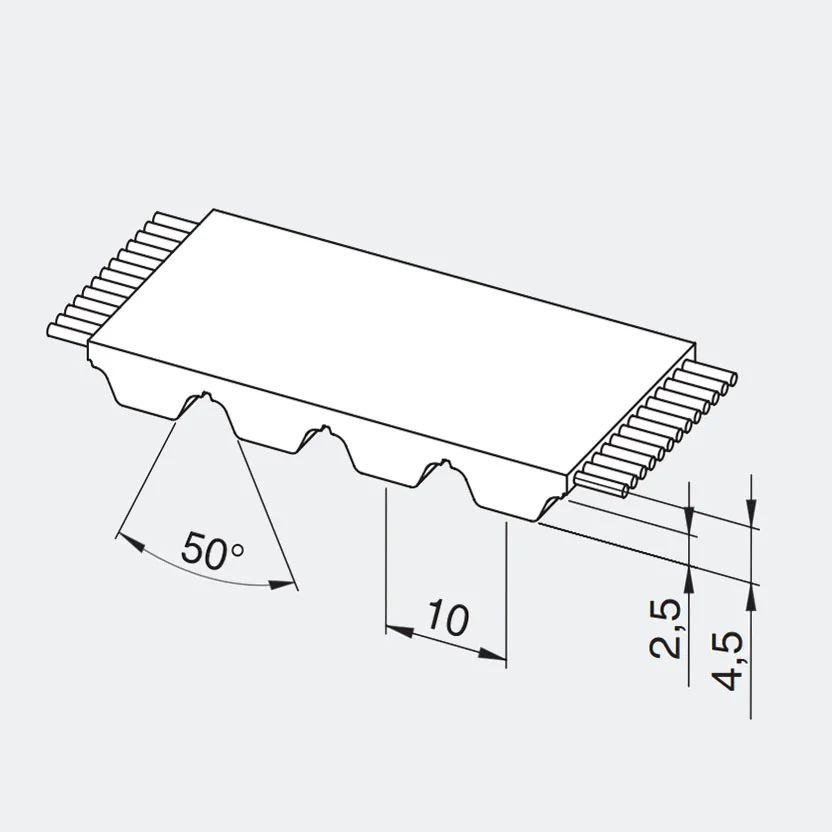




Conti Synchroflex AT10 GEN III 1080 is an endless, cast polyurethane timing belt with 108 teeth, 10 mm tooth pitch and a pitch length of 1080 mm. It is intended for synchronous power transmission, where the driving and driven shafts must follow a fixed tooth ratio without the slippage known from friction-based belt drives. The pitch length is the nominal length measurement in the belt cord line and is therefore the measurement that must be compared with the existing belt, the machine's spare parts data and the installed timing belt pulleys. The GEN III version is the reinforced high-performance construction with red high-performance polyurethane and denser, two-filament steel cord. It should therefore be treated as a separate product series and not as the regular standard version.
These specifications can be used as a check against the marking on the old belt or against the machine's spare parts list. The pitch length is not necessarily the same as a measurement across the outside of the belt, and the number of teeth is therefore often the safest additional check. If in doubt, both the belt and timing belt pulleys should be examined before ordering a replacement.
The metric AT geometry has trapezoidal teeth with a larger tooth volume than the standard T profile. The purpose is to distribute the load advantageously in the tooth mesh and achieve higher tooth strength without making the drive unnecessarily large. The profile requires suitable AT timing belt pulleys with the same pitch; a visual similarity to other profiles is not evidence of compatibility.
Conti Synchroflex is manufactured by casting, where the polyurethane is precisely shaped to the tool's tooth geometry around the embedded steel cord tension elements. The casting process provides high pitch accuracy over the entire circumference of the belt and a strong connection between PU and cord. The finished timing belt is endless and therefore has no welded joints. The polyurethane provides a wear-resistant tooth and back surface, while the steel cord takes the longitudinal tensile load.
The red GEN III construction is not just a color variant. It is developed with higher cord density and a special steel cord construction that provides increased tensile strength, better grooveing and the ability to carry higher loads. The catalog also specifies a temperature range up to +100 °C. Standard and GEN III must therefore be created and selected as separate products, even when the length and profile are the same.
It is not enough to compare the total circumference of a belt. The correct replacement must have the same pitch, tooth profile and number of teeth as the existing drive. The width must match the pulleys and the required capacity, and a DL or GEN III version must be identified separately. If in doubt, pictures of the marking, tooth profile and pulleys can be used as a supplement, but a documented spare part designation is best.
Continental cites construction machinery, pu , paper machines, compressors, compactors, textile machines and roller conveyor drives as examples for this profile family. The examples describe the profile's general area of application, but do not constitute an approval for any specific installation. The final belt width and pretension must be selected based on the transmitted torque, starting and shock loads, operating time, pulley sizes, speed and the number of teeth in simultaneous engagement. For safety-critical or heavily loaded drives, an actual calculation should be made.
This product line has been created with 16 mm as the base width because this is the width of the selected item and thus the SKU used for inventory control. Integer widths from 16 to 50 mm can be selected on this product page. The widths that appear as standard widths in the supplier data are marked separately in the options. The price surcharge is calculated as a percentage of the base width: doubling the width results in a surcharge of 100%. The technically necessary width should be selected according to the load and not only according to the price.
The pulleys and belt should be considered as a single tooth engagement. Proper AT10 GEN III geometry ensures that the load is distributed across the tooth flanks rather than concentrated on tooth tips or edges. The drive ratio is selected by the number of teeth on the pulleys, while the belt's 108 teeth and 1080 mm pitch length determine the required combination of pulleys and center distance. When changing the drive, the geometry should be calculated.
When installing, the cord pullers must be protected against kinks and local pressure damage. The belt must not be pinched with pliers or a screwdriver, and it should not be folded sharply. Check that the pulleys have the same pitch and profile as the belt and that they are not worn out. A stable drive is achieved through the right combination of alignment, wrapping and calculated pretension.
Continental specifies a temperature range of up to +100 °C for the GEN III series. When operating close to the temperature limits, the drive must still be dimensioned according to the specific load and environmental conditions. The timing belt operates without lubrication, and oil or grease should therefore not be added to dampen noise. The polyurethane is described as resistant to aging as well as simple oils, grease and petrol and to certain acids and bases. In the case of permanent contact, cleaning chemicals or unknown media, material compatibility should be specifically clarified.
Early damage is often caused by conditions surrounding the belt rather than the material itself. Bent shafts, worn tooth grooves, foreign objects and incorrect pretensioning can all shorten the service life. In the event of a belt break, the pulleys should therefore be cleaned and inspected before the new belt is fitted. Also check whether load conditions or start-stop cycles have changed since the original design.
Check that the belt runs centrally, that there is no abnormal heat or noise, and that the edges are not constantly rubbing against the flanges. Also look for signs of too low or too high pretension. If the drive requires a re-tension check, the machine manufacturer's procedure must be followed.
Pulleys should be evaluated if the tooth grooves are worn, sharp, crooked or damaged. A new belt on worn pulleys may have poor load distribution and short life. Also check flanges for bars and side contact and the grooves for foreign objects.
The standard version is single-sided with teeth on the inside and a smooth back. It must run with the teeth in the corresponding tooth grooves; the back is not an alternative tooth side.
The pitch length is the nominal length measured in the belt cord line where the steel cord tension elements are located. It is not the same as a random outer circumference measurement. For this belt, 1080 mm pitch length corresponds to 108 teeth with a 10 mm tooth pitch.
Continental states that the GEN III version can be used on standard timing belt pulleys for the corresponding AT10 profile. However, the pulleys must be in good condition and the drive must be dimensioned for the load you want to utilize.
The Conti Synchroflex series is designed for precise and fast synchronous drives, but the permissible speed depends on the profile, pulley diameter, belt width, load and peripheral speed. A high speed must therefore not be approved based on the product name alone; the drive must be calculated.
No. All width choices on this product page have the same pitch length of 1080 mm and the same number of teeth of 108. Only the width of the belt, and thus the price and possible load capacity, changes. The width must still match the pulleys and the technical dimensioning.
Conti Synchroflex AT10 GEN III 1080 is the correct size when the drive requires AT10 GEN III, 1080 mm pitch length and 108 teeth. The belt is cast endless in PU with steel cord and must be used with timing belt pulleys that match the profile. Choose the width according to the technical load and always check the design, alignment and pretension before commissioning.


