
New
DISCOUNTED


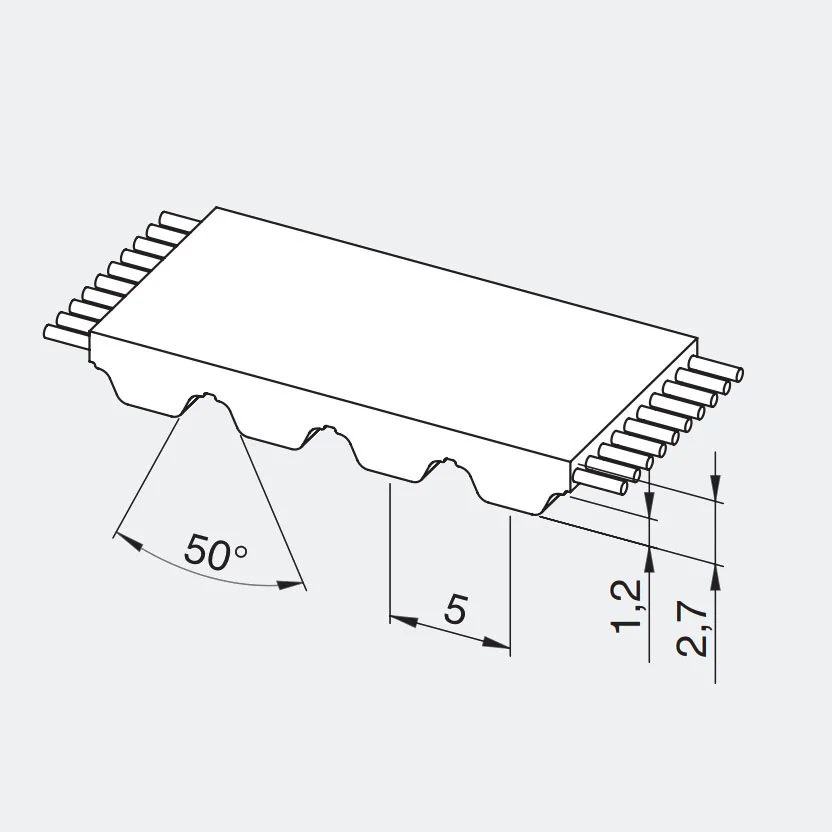




With 180 teeth distributed over a pitch length of 900 mm, the Conti Synchroflex AT5 GEN III 900 is designed for precise transmission of rotation, stroke and position. The belt is cast endlessly in PU and has integrated steel cord tension elements that stabilize the length during normal operation. The nominal tooth pitch is 5 mm and the tooth profile must match the profile of the pulleys precisely. It is not sufficient for another belt to have approximately the same length or width. The GEN III version is the reinforced high-performance construction with red high-performance polyurethane and denser, two-filament steel cord. It should therefore be treated as a separate product series and not as the usual standard version.
These specifications can be used as a check against the marking on the old belt or against the machine's spare parts list. The pitch length is not necessarily the same as a measurement across the outside of the belt, and the number of teeth is therefore often the safest additional check. If in doubt, both the belt and timing belt pulleys should be examined before ordering a replacement.
The metric AT geometry has trapezoidal teeth with a larger tooth volume than the standard T profile. The purpose is to distribute the load advantageously in the tooth mesh and achieve higher tooth strength without making the drive unnecessarily large. The profile requires suitable AT timing belt pulleys with the same pitch; a visual similarity to other profiles is not evidence of compatibility.
With the cast manufacturing method, the finished belt becomes an exact copy of a precision-machined shape. This is a major reason for the uniform tooth pitch and reproducible length. The steel cord is integrated into the polyurethane and contributes to position and angular precision. The design is suitable for synchronous drives, where a conventional elastic friction belt does not provide the desired repeatability.
GEN III is the reinforced high-performance version of the Conti Synchroflex series. The construction uses red high-performance polyurethane, more densely packed steel cord tension elements and a two-filament construction with balanced S and Z cords. Continental states up to 25% higher power transmission than the corresponding AT or ATP standard series. GEN III can use the standard profile timing belt pulleys, but the belt still needs to be dimensioned for the specific drive.
The application examples in the catalogue include machine tools, pu , textile machines and positioning and conveying systems. This shows that the profile can be used in both power transmission and motion control. However, the specific belt must only be finally selected when the machine's torque, speed, center distance and pulley geometry are known. When simply replacing a spare part, the safest method is usually to copy the documented profile, length, design and width.
The basic price applies to 6 mm, and the other widths are calculated with the same percentage logic as the existing PU timing belts in the webshop. Integer widths from 6 to 50 mm can be selected on this product page. A width of twice the basic width therefore costs 100% more, while a width of one and a half times the basic width gives approximately 50% extra. This price rule is a webshop calculation; it does not replace a technical dimensioning of the belt's load-bearing capacity.
A belt with the correct length can still function poorly if the pulleys have the wrong profile, are worn or are misaligned. Therefore, check the tooth grooves, flanges, shaft alignment and the number of teeth on the pulleys. For AT5 GEN III, the nominal tooth pitch is 5 mm. The fixed tooth mesh makes the gear ratio reproducible, but only when the belt has sufficient wrap and does not run with constant side pressure.
When installing, the cord pullers must be protected against kinks and local pressure damage. The belt must not be pinched with pliers or a screwdriver, and it should not be folded sharply. Check that the pulleys have the same pitch and profile as the belt and that they are not worn out. A stable drive is achieved through the right combination of alignment, wrapping and calculated pretension.
The product's 180 teeth provide a convenient length check. Multiplying the number of teeth by 5 mm gives a pitch length of 900 mm. If an existing belt has a different number of teeth, it is not the same size, even though it may look almost the same length. Also check that the teeth on the pulleys match AT5 GEN III; the same pitch number alone is not always sufficient.
A properly running timing belt should move smoothly without continuous contact against one flange. Regularly check the teeth for deformation, the back for ctiming bars and the edges for frayed areas. Abnormal noise or heat can be an early sign of incorrect tension or pulley failure. A systematic check of pulleys and belt is more effective than trying to hide symptoms with lubricant.
Continental specifies a temperature range of up to +100 °C for the GEN III series. When operating close to the temperature limits, the drive must still be dimensioned according to the specific load and environmental conditions. The cast PU belt is maintenance-friendly and does not require lubricant. Regular visual inspection is still relevant: look for ctiming bars, frayed edges, shiny tooth flanks, foreign body impressions and abnormal side contact. Sudden changes in noise or grooveing can be signs of misalignment, too low tension or worn pulleys.
This product is already GEN III. The reinforced version features high-performance PU and denser, two-filament steel cord construction and is a separate product line from the standard belt.
The number of teeth links the pitch of the profile to the nominal length of the belt. For this size, 180 teeth at 5 mm pitch gives a length of 900 mm. It is a simple check that often reveals faults that are not visible by a quick comparison of two loose belts.
The documented supplier widths for this size include 6, 8, 10, 12, 16, 20, 25, 32 and 50 mm. The product page may also show intermediate sizes as cut widths when they are within the allowed range. This does not change the tooth profile or length, but the price is calculated based on the base width.
Correct pretension keeps the teeth in stable engagement and reduces the risk of tooth jump. Too low a tension can cause impact and jump under load, while too high a tension increases the load on the cord, pulleys and bearings. The correct value must be determined based on the drive's dimensioning.
Yes, the belt width can usually be measured directly on the flat back or between clean, undamaged edges. However, the width is only one part of the identification. The profile, pitch length, number of teeth and any DL or GEN III version must also be correct.
This should be avoided. The belt should be installed by adjusting the center distance or following the correct installation procedure for the machine. Forcing it over a flange can damage the cord pullers, teeth or belt edge. After installation, the pulleys must be parallel and the pretension must be correct.
Noise can be caused by incorrect pretension, skewed pulleys, poor tooth profile compatibility, excessive speed, resonance or worn tooth grooves. Lubrication is not the solution. First check alignment, tension, pulley condition and whether the belt runs without abnormal side contact.
The product brings together the specified AT5 GEN III profile and length on one side, so that the appropriate width can be selected without creating a separate item for each cut. The main technical data is 900 mm pitch length and 180 teeth. If in doubt about load or pulley compatibility, the drive should be calculated before ordering the belt.


